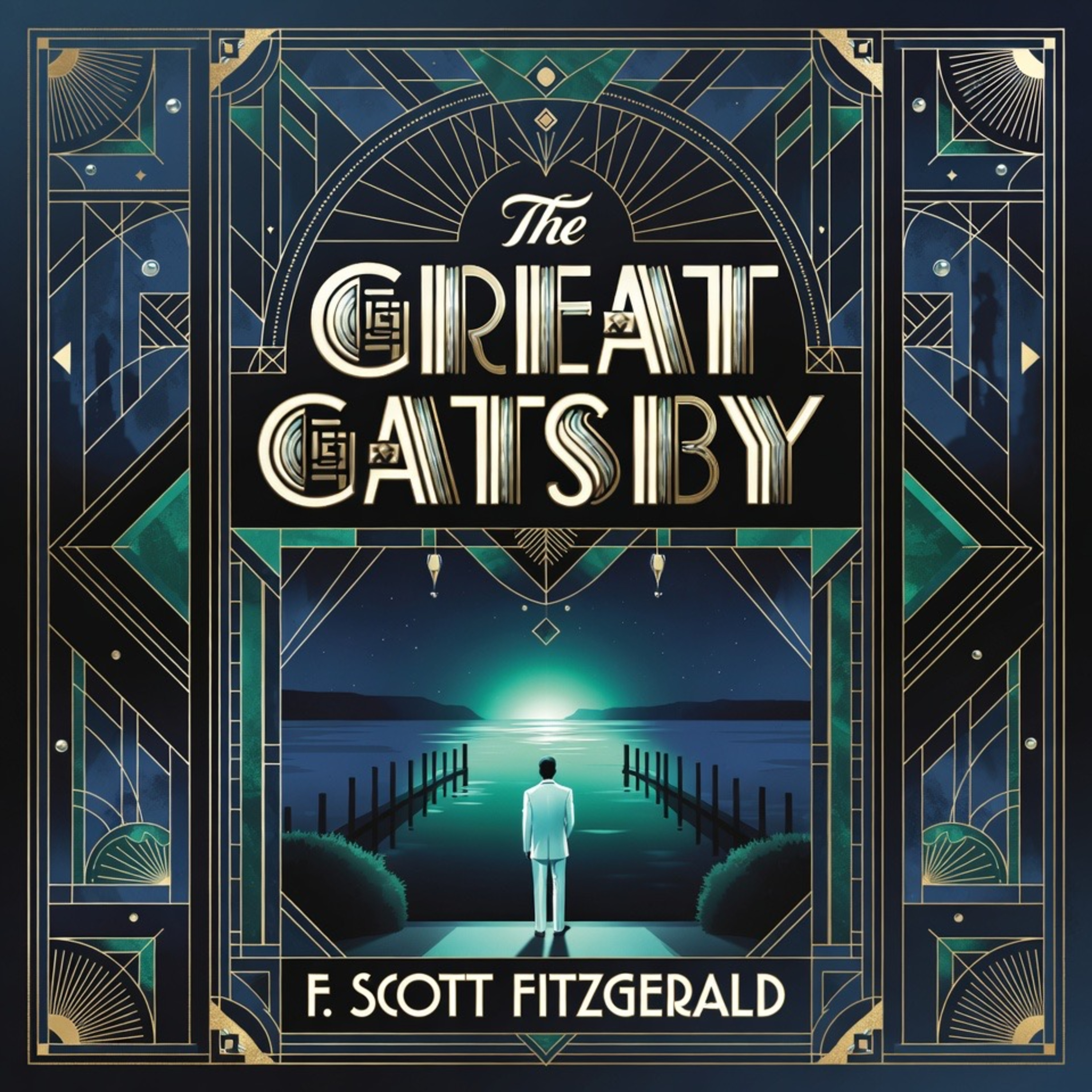
The Great Gatsby - Chapter Six | Full Audiobook
The Story
This episode is sponsored by Wexley Pro, a professional, mobile-first book-production studio for iPhone.
Write, edit, format, and export complete books in EPUB, DOCX, and print-ready PDF formats, with local-first manuscript processing designed to keep your creative work under your control.
Discover Wexley Pro: https://wexley.pro
In Chapter Six, the dream starts showing its first cracks. We finally learn who Gatsby really is — not the Oxford man, not the war hero, not the heir to a Midwestern fortune. His real name is James Gatz, son of poor North Dakota farmers, a seventeen-year-old who looked out at a rich man's yacht one afternoon and decided to become someone else entirely. Jay Gatsby was never born. He was invented. And everything since — the mansion, the parties, the shirts, the green light — has been the construction project of a boy who refused to accept the life he was given. Then Tom Buchanan arrives at one of the parties, and the two worlds Gatsby has been carefully keeping apart end up in the same room. Tom is suspicious, dismissive, and quietly dangerous. Daisy moves through the crowd looking faintly unsettled — like she's reaching for something beautiful she's not sure she's allowed to have. And when the night ends and everyone is gone, Gatsby tells Nick the one thing that reveals everything. He doesn't want to move forward. He wants to go back. All the way back. To repeat the past as if five years never happened. Nick tells him you can't repeat the past. Gatsby looks at him like that's the strangest thing he's ever heard. Follow the show so you never miss a chapter, and drop a comment with the classic you want us to read next — your suggestion could become our next season.
Welcome back to chapter by Chapter, the audiobook experience. We're continuing The Great Gatsby by F Scott Fitzgerald. If this is your first time here, start from the beginning of this season and follow Nick Carraway's story from the very start. And if you've been with us since Chapter 5, welcome back. Gatsby got what he wanted. Daisy is back. The dream he spent five years building is finally standing in his living room. But dreams have a way of becoming complicated the moment they become real. Follow the show so you never miss a chapter and drop a comment with the classic you want us to read next.
Now sit back and let's continue the story. Chapter 6. Around this time, a young and ambitious reporter from New York showed up 1 morning at Gatsby's doorstep, asking if he had any comments to make. Comments on what? Gatsby asked politely. Well, any statement you'd like to give? After a muddled 5 minutes, it became clear that the reporter had caught wind of Gatsby's name in his office, linked to something he either couldn't disclose or didn't fully grasp. It was his day off and with commendable initiative, he had rushed over to see.
It was a shot in the dark, yet the reporter's instincts were spot on. Gatsby's fame, fueled by the hundreds who had enjoyed his hospitality and thus became self-proclaimed experts on his past, had grown all summer, almost reaching the threshold of newsworthiness. Contemporary myths like the underground pipeline to Canada clung to him, and there was a persistent rumor that he didn't live in a house at all, but on a boat disguised as a house, secretly moving up and down the Long Island shore. Why these fabrications pleased James Gatz of North Dakota is hard to pinpoint.
James Gatz. That was his real, or at least legal, name. He had changed it at 17, at the precise moment marking the start of his career, when he saw Dan Cody's yacht anchor over the most treacherous flat on Lake Superior. It was James Gatz who had been wandering along the beach that afternoon in a ragged green jersey and canvas pants. But it was already Jay Gatsby who borrowed A rowboat, paddled out to the and warned Cody that a gust might catch him and tear him apart within half an hour. I suspect he had the name ready long before.
Even then. His parents were aimless and unsuccessful farmers. He never truly accepted them as his own. In truth, Jay Gatsby of West Egg, Long Island emerged from his idealized vision of himself. He saw himself as a son of God, a phrase that, if it holds any meaning, means precisely that. And he felt destined to carry out his work serving a vast, gaudy and deceptive beauty. So he crafted the kind of Jay Gatsby a 17 year old might dream up, and he remained loyal to this vision until the end. For over a year he had been making his way along the southern shore of Lake Superior, working as a clam digger, a salmon Fisher, or in any job that provided food and shelter.
His body, bronzed and toughening, adapted naturally to the half intense, half leisurely rhythm of those invigorating days. He became acquainted with women early on, and since they indulged him, he grew disdainful of them, scornful of young virgins for their naivety and of others for their hysteria over matters he, in his overwhelming self focus, took for granted. Yet his heart was in constant chaotic turmoil. The most bizarre and fantastical ideas haunted him at night as the clock ticked on the washstand and the moon drenched his scattered clothes with its damp light.
Each night he wove more into the tapestry of his fantasies until sleep enveloped A vivid scene with a forgetful embrace. For a time, these dreams offered an escape for his imagination. They suggested the unreality of reality, a promise that the foundation of the world rested securely on a fairy's wing. Driven by a sense of future greatness, he adventured months earlier to the modest Lutheran College of Saint Olaf's in southern Minnesota. His stay lasted a mere 2 weeks, as he was quickly disillusioned by the institution's stark indifference to the grand Symphony of his destiny, and he loathed the janitorial work that was meant to fund his education.
Disheartened, he returned to Lake Superior, still in search of purpose when Dan Cody's yacht anchored in the nearby shallows. Cody, then 50, was a veteran of the Nevada silver mines, the Yukon and every gold rush since 1875. His ventures in Montana copper had made him a multi millionaire, leaving him physically robust but teetering on the edge of mental decline. Aware of this vulnerability, countless women sought to part him from his wealth. Among them, Ella Kaye, A journalist with questionable motives, manipulated his weaknesses, leading him to a life at sea on a yacht, a story well known in the sensational journalism OF19-O2.
For five years he had drifted along, welcoming shores until he became a pivotal figure in the life of James Gatz at Little Girl Bay. To the young Gatsby, who paused his rowing to gaze up at the yacht's deck, it embodied all the allure and splendor the world had to offer. Perhaps he smiled at Cody, having learned that his smile was well received. Whatever the case, Cody engaged him in conversation, during which Gatsby revealed his new identity and demonstrated his quick wit and boundless ambition.
Within days, Cody took him to Duluth, outfitting him with a blue coat, 6 pairs of white duck trousers, and a yachting cap. When the Ptolemy set sail for the West Indies and the Barbary Coast, Gatsby departed as well. He worked in a nebulous personal role during his time with Cody. He served as steward, mate, skipper, secretary, and even jailer. Dan Cody Sober was acutely aware of the extravagant escapades Dan Cody Drunk might embark upon, and thus he increasingly relied on Gatsby to manage such eventualities.
This arrangement endured for five years, during which the yacht circled the continent three times. It might have continued indefinitely had Ella Kay not boarded one night in Boston, and a week later Dan Cody met an untimely death. I repall the portrait of him in Gatsby's bedroom, a Gray Florida man with a hard, vacant expression, the original debauchee who, in a certain era of American history, brought the wild excesses of the frontier brothel and saloon back to the Eastern seaboard. It was indirectly because of Cody that Gatsby drank so sparingly.
At lively gatherings, women would sometimes rub champagne into his hair. For his part, he developed the habit of abstaining from alcohol. From Cody, Gatsby was supposed to inherit a sum, $25,000. He never received it. He never grasped the legal maneuver that deprived him of it. But the remainder of Cody's fortune went entirely to Ella K. He was left with an education that fit him perfectly. The once indistinct outline of Jay Gatsby had solidified into the presence of a real man. He shared all this with me much later, but I've included it here to dispel those early wild rumors about his background, which were entirely unfounded.
He confided in me during a time of uncertainty, when I was caught between believing everything and nothing about him. So I take this brief pause while Gatsby, metaphorically speaking, caught his breath to dispel these misconceptions. It was also a pause in my involvement with his affairs. For several weeks, I neither saw him nor heard his voice over the phone. I was mostly in New York, spending time with Jordan and trying to win over her elderly aunt. But eventually I visited his house one Sunday afternoon.
I had barely arrived when someone brought Tom Buchanan in for a drink. I was surprised, of course, but the real surprise was that it hadn't happened sooner. They were a group of three on horseback, Tom, a man named Sloan and an attractive woman in a brown riding outfit who had been there before. I'm delighted to see you, said Gatsby, standing on his porch. I'm delighted that you dropped in. As if they truly cared. Please take a seat. Would you like a cigarette or a cigar? He moved briskly around the room, ringing bells.
I'll have a drink ready for you in just a moment. The presence of Tom deeply unsettled him, yet he would remain uneasy until he had offered them something. Vaguely aware that was their sole expectation, Mr. Sloan declined. Everything. A lemonade? No, thank you. A bit of champagne, Nothing at all. Thank you. I'm sorry, did you enjoy your ride? The roads are quite good around here, I suppose. The cars, yes. Compelled by an irresistible urge, Gatsby turned to Tom, who had accepted the introduction as if they were strangers.
I believe we've met before, Mr. Buchanan. Oh yes, Tom replied gruffly, courteous, clearly not recalling. So we did. I remember very well about two weeks ago. That's right, you were with Nick here. I know your wife, Gatsby said, a tone almost confrontational. Is that so? Tom turned to me. Do you live nearby, Nick? Right next door. Is that so? Mr. Sloan didn't join the conversation, reclining arrogantly in his chair. The woman remained silent too, until after two highballs, she suddenly warmed up.
She's beautiful, Daisy remarked. The man leaning over her is her director. Gatsby LED them with ceremony from group to group, Misses Buchanan and Mr. Buchanan. After a brief pause, he added the polo player. Oh no, Objected Tom swiftly. Not me. Apparently the nickname amused Gatsby, as Tom was referred to as the polo player for the rest of the night. I've never met so many famous people. Daisy exclaims. I liked that man. What was his name? With the sort of bluish nose Gatsby identified him, mentioning that he was a minor producer.
Well, I liked him anyway. I'd prefer not to be the polo player, Tom said with a smile. I'd rather watch all these celebrities from a distance. Daisy and Gatsby danced. I was struck by his elegant, understated foxtrot. I had never seen him dance before. Later, they strolled over to my house and sat on the steps for half an hour while I stayed alert in the garden at her request. In case there's a fire or a flood or any act of God. Tom emerged from his seclusion as we were about to sit down for supper.
Do you mind if I join some people over here? He asked. Someone's telling some amusing stories. Go ahead. Daisy responded warmly. And if you want to jot down any addresses, here's my little gold pencil. After a moment, she glanced around and remarked to me that the girl was common but pretty, and I realized that aside from the half hour she spent alone with Gatsby, she wasn't enjoying herself. We found ourselves at a particularly inebriated table, and I had only myself to blame. Gatsby had been called away to the phone, and I had enjoyed the company of these same people just two weeks prior.
Yet what had once amused me now felt sour and unpleasant. How are you feeling, Miss Bodacre? The girl in question was attempting, without success, to lean against my shoulder at the question. She straightened up and opened her eyes. Huh. A large, languid woman who had been trying to persuade Daisy to join her for golf at the local club the next day spoke up in Miss Bodacre's defense. Oh, she's fine now. After 5 or 6 cocktails, she always starts screaming like that. I keep telling her she should steer clear of them.
I do steer clear, Miss Botiker replied, her voice hollow. We heard you yelling, so I said to Doc Civet. Here. There's someone who could use your help, Doc. She's grateful, I'm sure, remarked another friend, lacking any real gratitude. But you soaked her dress when you dunked her head in the pool. The one thing I hate is getting my head dunked in a pool, Miss Botiker muttered. They nearly drowned me once over in New Jersey. And then you should steer clear, Doctor Civet retorted. Speak for yourself, exclaimed Miss Bodeker with intensity.
Your hand is trembling. I wouldn't trust you to operate on me. That's how it was. One of the last things I recall is standing with Daisy, observing the film director and his star. They remained beneath the white plum tree, their faces nearly touching, separated only by a slender beam of moonlight. It struck me that he had been gradually leaning toward her all evening to reach this closeness, and even as I watched, he bent that final fraction and kissed her cheek. I like her, Daisy remarked. I think she's lovely.
Yet the rest of it disturbed her undeniably, because it wasn't just a gesture but a feeling. She was unsettled by West Egg, this extraordinary place that Broadway had spawned upon a Long Island fishing village, unsettled by its raw energy that chafed against old niceties and the overt destiny that drove its residents on a shortcut from nowhere to nowhere. She perceived something dreadful in the very simplicity she couldn't grasp. I sat with them on the front steps as they waited for their car. It was dark here in front, only the bright doorway cast a rectangle of light into the gentle blackness of the morning.
Occasionally a shadow moved against a dressing room blind above, replaced by another shadow, an endless parade of silhouettes who applied Rouge and powder before an unseen mirror. Who is this Gatsby anyway? Tom asked abruptly. Some big time, bootlegger. Where'd you hear that? I asked. I didn't hear it. I just figured a lot of these newly wealthy folks are just big bootleggers, you know? Not Gatsby, I replied curtly. He paused, the gravel crunching under his shoes. Well, he must have gone to great lengths to assemble this zoo.
A breeze stirred the soft Gray fur of Daisy's collar. At least they're more interesting than the people we usually meet. She said, trying to sound enthusiastic. You didn't seem that interested. Well, I was. Tom chuckled and turned to me. Did you catch Daisy's expression when that girl asked her to put her under a cold shower? Daisy began to sing along with the music in a Husky, rhythmic whisper, infusing each word with a new meaning it had never held before and would never hold again. As the melody soared, her voice broke sweetly, following it in that way contralto voices do each shift releasing a bit of her warm human magic into the air.
Lots of people show up who weren't invited. That girl wasn't invited. They just push their way in. And he's too courteous to protest. I want to know who he is and what he does. Tom insisted. I think I'll make it a point to find out. I can tell you right now, she replied. She owned a chain of drug stores, a lot of them. He built them up himself. The slow moving limousine rolled up the drive. Good night, Nick, Said Daisy. Her gaze drifted from me to the illuminated top of the steps, where 3:00 in the morning, a neat, melancholic waltz of that year floated through the open door.
Despite the casual nature of Gatsby's party, there were romantic possibilities entirely absent from her own world. What was it in the song that seemed to beckon her back inside? What might unfold in the dim, unpredictable hours ahead? Perhaps some extraordinary guest would arrive, Someone incredibly rare and wondrous, a truly radiant young girl who, with one fresh glance at Gatsby, 1 moment of enchanting encounter, would erase those five years of unwavering devotion. I stayed late that night. Gatsby asked me to wait until he was free, so I lingered in the garden until the inevitable swimming party returned, chilled and exhilarated from the dark beach until the lights went out in the guest rooms above.
When he finally descended the steps, his tanned skin was pulled unusually tight across his face and his eyes were bright yet weary. She didn't like it, he said immediately. Of course she did. She didn't enjoy it, he insisted. She didn't have a good time. He fell silent, and I sensed the depth of his unspoken despair. I feel distant from her, he said. It's hard to make her understand. Are you talking about the dance? The dance? He dismissed all the parties he'd thrown with a flick of his fingers.
Old sport. The dance doesn't matter. What he wanted from Daisy was nothing less than for her to go to Tom and say I never loved you. With those words, she would erase four years and they could then figure out the practical steps to take. One of those steps was that once she was free, they would return to Louisville and Mary from her home, just as if it were five years ago. And she doesn't understand, he said. She used to be able to understand. We'd sit for hours. He stopped and began pacing a forlorn path strewn with fruit peels, discarded favors, and crushed flowers.
I wouldn't ask too much of her. I suggested gently. You can't repeat the past. Can't repeat the past. He exclaimed incredulously. Why, of course you can. He glanced around frantically, as if the past were hiding in the shadows of his house, just beyond his reach. I'm going to set everything back to how it was. He declared with a resolute nod. She'll understand. He spoke often of the past, and I sensed he was trying to reclaim something, perhaps an idea of himself that had been lost in his love for Daisy.
His life had been chaotic and unsettled since then, but he believed that if he could return to a certain point and revisit it all slowly, he might discover what that elusive thing was. 1 autumn night, five years earlier, they had been walking down the street as leaves fell around them. They reached a spot where there were no trees and the sidewalk was bathed in moonlight. They paused there and turned to face each other. It was a cool night, filled with the mysterious thrill that accompanies the changing of the seasons.
The quiet lights from the houses hummed into the darkness, and the stars seemed to stir with activity. Out of the corner of his eye, Gatsby noticed that the blocks of the sidewalk formed a ladder leading to a secret place above the trees. He could ascend it if he climbed alone, and once there, he could drink deeply from the essence of life, savoring the unparalleled milk of wonder. His heart raced as Daisy's pale face drew near his own. He realized that when he kissed this girl, binding his indescribable dreams to her fleeting breath, his mind would never again frolic like the mind of God.
So he waited, listening a moment longer to the tuning fork that had been struck upon A star. Then he kissed her. At the touch of his lips, she opened up to him like a flower in bloom, and the transformation was complete. In everything he said, even through his overwhelming sentimentality, I was reminded of something. A fleeting rhythm, a fragment of forgotten words that I had heard somewhere long ago. For a moment a phrase tried to form on my lips, and they parted like those of a mute person, as if more than just a breath of startled air was struggling to emerge.
But no sound came, and what I had nearly recalled slipped away forever beyond communication. And that brings us to the close of Chapter 6 of The Great Gatsby by F Scott Fitzgerald. This chapter finally gave us the truth beneath the myth. His real name, his real origins. A dirt poor farm kid from North Dakota who looked out at a rich man's yacht one afternoon and decided on the spot to become someone else entirely. Jay Gatsby was never born. He was invented by a 17 year old with nothing but nerve and an unshakeable belief in his own destiny.
We watched Tom arrive at the party and immediately start asking questions. We watched Daisy move through Gatsby's world and find it beautiful and troubling all at once. And we watched Gatsby after the lights went out and everyone went home, standing alone in his garden, telling Nick something that stops you cold. He wants to repeat the past, not revisit it, not remember it, repeat it, erase five years and start again. From the moment he kissed her, as if time itself could be forced to obey him. Nick tells him you can't repeat the past.
Gatsby looks at him like he said something almost too foolish to answer. That gap between what Gatsby believes is possible and what the world will actually allow is where everything from here is headed. Thank you for listening to chapter by chapter the audio book experience. If this story has its hooks in you, follow the show so the next chapter finds you automatically. Like this episode and drop a comment with the classic you want us to read next. Your suggestion could become our next season. The next chapter is already waiting for you.
 Apple Podcasts
 Castbox
 Castro
 Goodpods
 Moon FM
 Overcast
 Pocket Casts
 Podbean
 Podcast Addict
 Podcast Republic
 Spotify