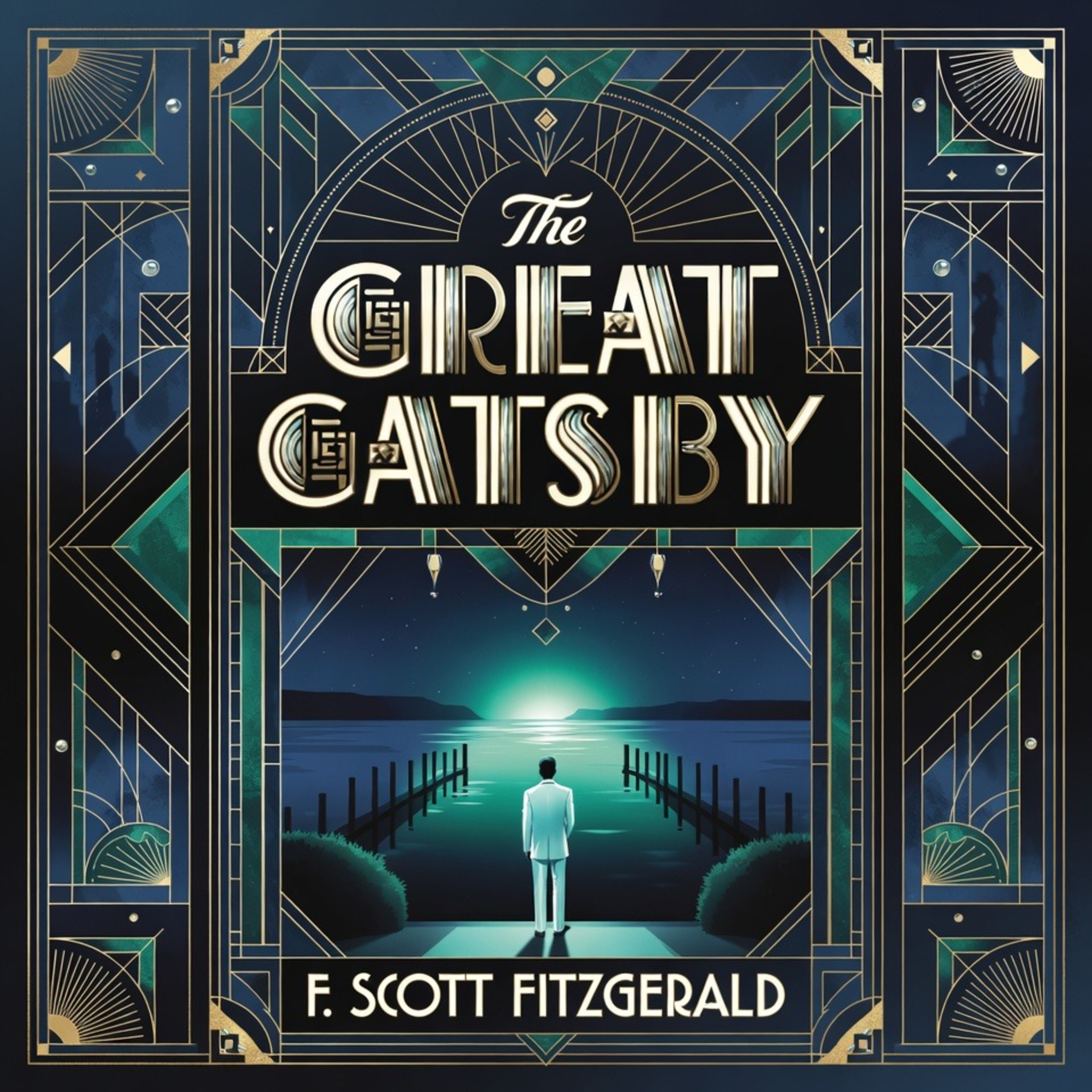
The Great Gatsby - Chapter One | Full Audiobook
The Story
This episode is sponsored by Wexley Pro, a professional, mobile-first book-production studio for iPhone.
Write, edit, format, and export complete books in EPUB, DOCX, and print-ready PDF formats, with local-first manuscript processing designed to keep your creative work under your control.
Discover Wexley Pro: https://wexley.pro
Welcome to Season 3 of Chapter by Chapter — An Audiobook Experience. This season we're reading The Great Gatsby by F. Scott Fitzgerald, one of the most iconic American novels ever written and now part of the public domain.
In Chapter One, we meet Nick Carraway — a young Midwesterner newly arrived in New York, navigating old money, new wealth, and the glittering, hollow world of the East Egg elite. A dinner party reveals beautiful people hiding ugly secrets, and the night ends with a mysterious neighbor reaching toward a distant green light across the water.
The Jazz Age begins here.
Follow the show so you never miss a chapter, and drop a comment with the classic you want us to read next — your suggestion could become our next season.
Welcome back to Chapter by Chapter, the audiobook experience where timeless stories find new voices. Today we begin one of the most iconic novels of the 20th century, a story of obsession, reinvention, and the devastating cost of chasing a dream that was never really yours. The Great Gatsby by F Scott Fitzgerald, Chapter 1 In my younger, more impressionable years, my father offered me a piece of advice that has lingered in my thoughts ever since. Whenever you feel like criticizing anyone, he said, just remember that not everyone in this world has had the advantages you've had.
He left it at that, but we've always communicated in a reserved yet meaningful way, and I understood he implied much more. As a result, I tend to withhold judgment, a habit that has revealed many intriguing personalities to me and also made me the target of more than a few seasoned boars. An unusual mind quickly senses and clings to this trait when it appears in a typical person, which led to me being unfairly labeled a politician in college simply because I was Privy to the hidden sorrows of wild, unknown men.
Most of these confidences were unsolicited. I have often pretended to be asleep, distracted, or humorously indifferent when I sensed with unmistakable signs that a personal revelation was about to surface. For the intimate disclosures of young men, or at least the way they express them, are often derivative and marred by obvious omissions. Withholding judgment is an act of endless hope. I still fear missing something if I forget that, as my father somewhat snobbishly suggested, and I somewhat snobbishly echo, a sense of basic decency is unevenly distributed at birth.
And after boasting about my tolerance, I must admit it has its limits. Behavior may be rooted in solid ground or shifting sands, but beyond a certain point, I no longer care what it's based on. When I returned from the East last fall, I found myself longing for a world that stood perpetually at attention. Clad in moral uniformity, I craved an end to wild adventures and the privileged peaks into the human heart. Only Gatsby, the man whose name graces this book, escaped my newfound disdain. Gatsby, who embodied everything I instinctively scorned.
If personality is a seamless sequence of successful gestures, then there was something magnificent about him, a heightened sensitivity to life's promises, as though he were akin to one of those complex machines that detect earthquakes from 10,000 miles away. This responsiveness was not the same as the weak impressionability often mischaracterized as creative temperament. It was an extraordinary capacity for hope, a romantic readiness unlike anything I had ever encountered and likely never would again.
No, Gatsby turned out fine in the end. It was the things that preyed on him, the foul dust that trailed in the wake of his dreams, that temporarily dulled my interest in the feudal sorrows and fleeting joys of men. My family has been prominent and well off in this Midwestern city for three generations. The Caraways are somewhat of a clan with a tradition claiming descent from the Dukes of Baklu, though the true founder of our line was my grandfather's brother. He arrived here in 51, sent a substitute to fight in the Civil War, and established the wholesale hardware business that my father continues to run today.
I never met this great uncle, but I am said to resemble him particularly in the rather stern portrait that hangs in my father's office. I graduated from New Haven in 1915, exactly 25 years after my father, and shortly thereafter I took part in that delayed Teutonic migration known as the Great War. I enjoyed the counter raid so much that I returned feeling unsettled. What once felt like the warm center of the world, the Midwest, now seemed like the frayed edge of the universe. So I decided to head east and learn the bond business.
Everyone I knew was in bonds so I figured it could accommodate one more bachelor. My aunts and uncles disgusted as if they were picking a prep school for me and eventually with serious hesitant expressions they said why yes. My father agreed to support me for a year, and after some delays I moved E, thinking it was for good. In the spring of 22, the sensible thing was to find a place in the city. But it was a warm season and I had just left a land of sprawling lawns and friendly trees. So when a young colleague suggested we rent a house together in a commuter town, it seemed like a great idea.
He found the place, a weathered flimsy bungalow for 80 a month, but at the last moment the firm sent him to Washington, and I ended up in the countryside alone. I had a dog, at least for a few days, until he ran off, and an old Dodge, plus a Finnish woman who made my bed, cooked breakfast and muttered Finnish proverbs to herself over the electric stove. It was lonely for a day or two, until 1 morning. A man newer to the area than I was stopped me on the road. How do you get to West Egg Village? He asked, looking lost.
I gave him directions As I continued my walk. The loneliness vanished. I felt transformed into a guide, a trailblazer, a pioneer. He had effortlessly granted me the freedom of the neighborhood. With the sun shining and the trees bursting, with leaves growing as rapidly as scenes in a fast-paced film, I was filled with that familiar sense that life was starting anew with the arrival of summer. There was so much to explore, so much vitality to draw from the invigorating young heir. I bought a dozen books on banking, credit and investment securities, their red and gold covers gleaming like freshly minted coins, promising to reveal the luminous secrets known only to the likes of Midas, Morgan and Messinas.
I intended to read many other books as well. I had been quite literary in college. One year I penned a series of very earnest and straightforward editorials for the Yale News, and now I planned to reintroduce such pursuits into my life, aiming to become once more that narrowly defined of specialists, the well-rounded man. This isn't merely a clever saying. After all, life is more effectively viewed from a single vantage point. By chance, I had rented a house in one of the most peculiar communities in North America.
It was located on that slender, exuberant island stretching east of New York, where, among other natural oddities, 2 unusual land formations exist 20 miles from the city. 2 enormous eggs, identical in shape and separated only by a polite Bay, protrude into the most tamed body of salt water in the Western Hemisphere, the expansive aquatic barnyard of Long Island Sound. They aren't perfect ovals. Like the egg in the Columbus Tail, they are both flattened at the point of contact. But their physical resemblance must be a constant source of amazement to the goals soaring above to those without wings.
The most intriguing aspect is how these creatures differ in every way except for their shape and size. I lived in West Egg, the well, the less fashionable of the two places, though calling it that barely scratches the surface of the strange and somewhat sinister contrast between them. My house was perched right at the tip of the Egg, just 50 yards from the Sound, nestled between two enormous estates that rented for 12 or $15,000 a season. The one to my right was a colossal structure by any measure, an exact replica of a Normandy Hotel de Ville with a tower on one side, freshly built with a sparse covering of raw Ivy, a marble swimming pool, and over 40 acres of lawn and garden.
This was Gatsby's mansion, or more accurately since I didn't know Mr. Gatsby, it was a mansion occupied by a man of that name. My own house was an eyesore, but a minor 1, and it had been overlooked, which meant I had a view of the water, a partial view of my neighbor's lawn, and the comforting nearness of millionaires. All for $80.00 a month. Across the Polite Bay, the white palaces of the fashionable Easter eggs sparkled along the water, and the real story of the summer began on the evening I drove over there to have dinner with the Tom Buchanans.
Daisy was my second cousin once removed, and I had known Tom in college, just after the war. I had spent two days with them in Chicago. Her husband, among his various physical achievements, had been one of the most formidable football ends ever to play at New Haven, a national figure in his own right, one of those men who reached such a peak of limited excellence at 21 that everything afterward felt like an anticlimax. His family was incredibly wealthy. Even during his college days, his casual spending was often criticized.
But now he had left Chicago and arrived in the East in a way that was truly astonishing. For example, he had transported a string of polo ponies from Lake Forest. It was difficult to grasp that someone from my own generation could possess such wealth. I never understood why they moved E they had spent a year in France for no particular reason and then wandered restlessly from place to place wherever the rich gathered to play polo. Daisy mentioned over the phone that this move was permanent, but I didn't believe it.
I couldn't see into Daisy's heart, but I sensed that Tom would continue to drift somewhat wistfully in search of the dramatic excitement of some long lost football game. So it was that on a warm, breezy evening, I drove over to East Egg to visit 2 old friends whom I barely knew. Their house was even more extravagant than I had anticipated, a lively red and white Georgian colonial mansion overlooking the Bay. The lawn stretched from the beach to the front door, 1/4 of a mile away, leaping over sundials and brick paths and vibrant gardens.
Finally, as it reached the house, it climbed up the side in bright vines, as if propelled by its own momentum. The front was interrupted by a row of French windows, now a glow with reflected gold, and wide open to the warm breezy afternoon with Tom Buchanan standing on the front porch in riding clothes, his legs apart. He had changed since his days at New Haven. Now he was a robust straw haired man of 30 with a rather hard mouth and an arrogant demeanor. 2 piercing, arrogant eyes dominated his face, giving him the look of someone perpetually leaning forward with aggression.
Not even the flamboyant elegance of his riding attire could mask the immense power of his physique. He seemed to fill those polished boots to the point of straining the top laces, and you could see the powerful muscles shifting beneath his thin coat as his shoulder moved. It was a body built for immense force, a body with a cruel edge. His voice, a rough, Husky tenor, only reinforced the impression of his irritable nature. There was a hint of condescending authority in it, even towards those he liked, and there were men at New Haven who had despised him.
Now, don't assume my opinion on these matters is definitive, he seemed to imply. Just because I'm stronger and more of a man than you are. We were part of the same senior society, and though we were never close, I always sensed that he approved of me and wanted me to like him with a kind of harsh, defiant longing of his own. We chatted for a few minutes on the sunlit porch. I've got a nice place here, he remarked, his eyes darting restlessly. Grasping my arm, he turned me around, sweeping a broad, flat hand across the view, which included a sunken Italian garden, half an acre of deep, fragrant roses, and a stubby motorboat bobbing with the tide offshore.
It belonged to Domain, the oil man. He turned me around again, both polite and abrupt. We'll grow inside. We stepped through a lofty corridor into a bright, rosy hued room, delicately tethered to the house by French windows at each end. These windows stood slightly open, their white frames gleaming against the fresh grass outside, which seemed to extend a little into the room itself. A breeze swept through, sending the curtains billowing in at one end and out the other like pale flags, twisting them upward toward the ornate frosted ceiling and then rippling over the wine colored rug, casting shadows like wind over the sea.
The only thing completely still in the room was a massive couch where two young women reclined as if buoyed by an anchored balloon. Both were dressed in white, their garments fluttering as if they had just been swept back inside. After a brief flight around the house. I stood for a moment, listening to the snap of the curtains and the creak of a picture on the wall. Then came a boom as Tom Buchanan closed the rear windows and the captured wind subsided, leaving the curtains, the rug, and the two young women to gently settle back to the floor.
The younger woman was unfamiliar to me. She lay stretched out at her end of the divan, perfectly still, her chin slightly raised, as if balancing something precarious. If she noticed me from the corner of her eye, she gave no indication, so much so that I almost felt compelled to apologize for intruding. The other woman, Daisy, made a move to arise, leaning forward with a deliberate expression. Then she laughed, A delightful, whimsical laugh, and I found myself laughing too, as I stepped further into the room.
I'm so overwhelmed with happiness I can hardly move. She laughed again, as if she'd just delivered a clever line, and held my hand briefly, her eyes meeting mine with a promise that there was no one. She was more eager to see that was her way. She softly mentioned that the girl balancing nearby was named Baker. Some say Daisy's soft spoken manner was just to draw people closer, a critique that did nothing to diminish its charm. Meanwhile, Miss Baker's lips twitched and she gave me the slightest nod before quickly tilting her head back.
The object she was balancing must have wobbled, giving her a bit of a scare. Again, I felt an apology forming on my lips. Any display of complete self assurance tends to leave me in silent awe. I turned back to my cousin who began questioning me in her low, captivating voice. It was the kind of voice that the ear follows up and down, as if each sentence is a melody never to be repeated. Her face was both sad and beautiful, with bright, lively features, sparkling eyes, and a vibrant, passionate mouth.
Yet there was an excitement in her voice that lingered with the men who had cared for her. A compelling melody, a hushed listen, a promise of recent thrilling adventures, and more to come in the near future.
I shared with her that I had paused in Chicago for a day on my journey east, and how a dozen people had sent their love through me. Do they miss me? She exclaimed with a burst of excitement. The entire town feels empty without you. Every car has its left rear wheel painted black like a morning wreath, and there's a constant wailing echoing along the North Shore all night. How wonderful. Let's go back Tom. Tomorrow, she added suddenly, as if struck by a new thought. You should see the baby. I'd like that.
She's asleep now. She's three years old. Have you never seen her? Never. Well, you really should. She's Tom. Buchanan, who had been pacing the room with restless energy, paused and placed his hand on my shoulder. What are you up to, Mick? I'm in the bond business. With whom? I told him the name of the firm. Never heard of them. He said with a note of finality. This irked me. You will. I replied tersely. You will if you stick around the East. Oh, I'll be staying in the East, don't worry. He assured me, casting a glance at Daisy before returning his gaze to me as if he were on the lookout for something more.
I'd be a damn fool to live anywhere else at that moment. Miss Baker exclaimed absolutely with such abruptness that I jumped. It was the first thing she'd said since I entered the room. It seemed to surprise her as much as it did me, for she yawned and with a series of quick, graceful movements, stood up. I'm stiff, she complained. I've been lying on that sofa for as long as I can remember. Don't blame me, Daisy replied. I've been trying to get you to New York all afternoon. No thanks, Miss Baker said to the four cocktails just brought in from the pantry.
I'm absolutely in training. Her host looked at her incredulously. You are. He drowned his drink as if it was just a drop left in the glass. How you managed to accomplish anything is beyond me. I glanced at Miss Baker, curious about what she actually accomplished. I enjoyed looking at her. She was a slender, small breasted woman with a poised posture which she emphasized by arching her shoulders back like a young cadet. Her Gray sun bleached eyes met mine with a polite, mutual curiosity from a pale, charming, yet discontented face.
It struck me just then that I had seen her before, or at least a picture of her. You live in West Egg, She said with a hint of disdain. I know someone there. I don't know a single. You must know Gatsby. Gatsby. Daisy interjected. Who's Gatsby? Before I could explain that he was my neighbor, dinner was announced. Tom Buchanan, with a firm grip on my arm, steered me out of the room as if he were moving a chess piece to a new position. With a graceful, unhurried air, their hands resting lightly on their hips, the two young women LED us onto a porch bathed in the rosy glow of sunset, where 4 candles flickered in the gentle breeze.
Why candles? Daisy questioned, frowning. She extinguished them with a quick pinch of her fingers. In two weeks, it'll be the longest day of the year. She beamed at us. Do you always look forward to the longest day and then let it slip by? I always look forward to it and let it slip by. We should plan something. Miss Baker suggested with a yawn as she settled into her chair as if she was climbing into bed. All right, Daisy agreed. What should we plan? She turned to me, lost. What do people even plan?
Before she could respond, her gaze fixed on her little finger with a look of awe. Look, she complained. I heard it. We all looked. The knuckle was bruised a deep shade of black and blue. You did it, Tom, She accused. I know you didn't mean to, but you did. That's what I get for marrying a brute of a man. A big hulking physical specimen of AI. Hate that word, Hulking Tom objected irritably. Even as a joke, Hulking Daisy insisted sometimes she and Miss Baker would talk simultaneously in a manner that was unobtrusive and playfully inconsequential, never quite descending into mere chatter.
Their conversation was cool as their white dresses and their detached eyes, devoid of any real desire. They were present, accepting Tom and me with only a polite, pleasant effort to entertain or be entertained. They knew that soon dinner would end, and not long after the evening would be over and casually set aside. It was starkly different from the West, where an evening rushed from one phase to the next, driven by a constant unfulfilled anticipation or a sheer nervous dread of the moment itself.
You make me feel uncivilized, Daisy. I admitted on my second glass of Corky, but rather impressive claret. Can't you talk about crops or something? I meant nothing specific by this remark, but it was picked up in an unexpected way. Society's falling apart. Tom erupted with a fierce intensity. I've become incredibly pessimistic about the state of things. Have you read The Rise of the Colored Empires by this guy Goddard? No, I haven't, I replied, taken aback by his fervor. Well, it's an important book, and everyone should read it.
The premise is that if we're not careful, the white race will be completely overrun. It's all based on scientific evidence. It's been proven. Tom's getting quite deep, Daisy remarked with a vague, sorrowful air. He reads these serious books with big words. What was that word? We. These books are scientific, Tom insisted, casting an impatient glance at her. This guy has figured it all out. It's up to us, the dominant race, to be vigilant, or these other races will take over. We have to keep them in check.
Daisy whispered, winking fiercely at the blazing sun. You should move to California. Miss Baker began, but Tom cut her off by shifting heavily in his chair. The idea is that we're Nordics. I am, you are, and you are, He said, pausing for a fraction of a second before including Daisy with a slight nod, to which she winked at me again. And we've created everything that defines civilization, science, art, and all that. Do you see? His focus was almost pitiable, as if his once sufficient self satisfaction now left him wanting.
Just then, the phone rang inside, and the Butler stepped away from the porch. DZ seized the brief interruption, leaning toward me with a spark of excitement. I'll share a family secret, She whispered eagerly. It's about the Butler's nose. Want to hear it? That's exactly why I came over tonight. Well, he wasn't always a Butler. He used to Polish silver for a New York family with a service for 200. He polished from dawn to dusk, and eventually it affected his nose. Things went from bad to worse, Miss Baker interjected.
Yes, they did, until he finally had to quit. For a moment, the last rays of sun bathed her face with a tender glow. Her voice drew me in, breathless as I listened. Then the light faded, each beam slipping away with a gentle reluctance, like children leaving a beloved street at twilight. The Butler returned, whispering something to Tom, who frowned, pushed back his chair, and silently went inside, as if his departure sparked something in her. Daisy leaned in again, her voice vibrant and melodic. I love having you at my table, Nick.
You remind me of a rose. An absolute rose, Don't you think so? She turned to Miss Baker for confirmation. An absolute rose. This wasn't true. I'm not even remotely like a rose. She was improvising, yet there was a warmth in her words, as if her heart was reaching out, hidden within those breathless, thrilling phrases. Then, without warning, she tossed her napkin onto the table, excused herself, and went inside the house. Miss Baker and I exchanged A brief glance, deliberately devoid of meaning. I was about to speak when she sat up suddenly and said SHHHH in a cautionary tone.
A muted, passionate murmur was audible from the next room, and Miss Baker leaned forward unashamedly trying to listen. The murmur hovered on the edge of clarity, dipped, rose excitedly, and then stopped all together. This Mr. Gatsby you mentioned is my neighbor. I started. Don't talk. I want to hear what's happening. Is something happening? I asked innocently. Are you telling me you don't know? Miss Baker asked, genuinely surprised. I thought everyone was aware. I don't. Well. She hesitated. Tom has a woman in New York.
A woman? I echoed, bewildered. Miss Baker nodded. She could at least have the courtesy not to call him during dinner, don't you think? Before I could fully process what she meant, there was the rustle of a dress and the sound of leather boots on the floor, and Tom and Daisy returned to the table. It was unavoidable. Daisy exclaimed with a strange cheerfulness. She sat down, casting a searching glance at Miss Baker and then at me, and continued. I stepped outside for a moment. And it's so romantic out there.
There's a bird on the lawn. I think it might be a Nightingale that came over on the Cunard or White Star Line. It's singing away. Isn't it romantic, Tom? Very romantic, he added then to me with a note of despair. If there's enough light after dinner, I want to show you the stables. The phone rang inside, startling us, and as Daisy shook her head firmly at Tom, the topic of the stables, indeed all topics, seem to dissolve into thin air in the scattered remnants of the last five minutes at the table.
I recall the candles being lit again pointlessly, and I felt a strong urge to look directly at everyone, yet avoid meeting any eyes. I couldn't fathom what Daisy and Tom were thinking, but I doubted even Miss Baker, who seemed to have honed a certain resilient skepticism, could completely dismiss the insistent, shrill urgency of this uninvited 5th guest. To some, the situation might have held a certain allure, but my immediate impulse was to call the police. The horses, predictably, were never brought up again.
Tom and Miss Baker, separated by a stretch of twilight, wandered back into the library as if keeping watch over a palpable presence. Meanwhile, I trailed Daisy through a series of interconnected verandas to the porch at the front, trying to appear both amiably engaged and slightly hard of hearing in the porch's shadowy embrace. We settled side by side on a Wicker satay. Daisy cradled her face in her hands as if tracing its delicate contours, her eyes drifting slowly into the velvet darkness. I could sense the storm of emotions within her, so I ventured with what I hoped were calming inquiries about her little girl.
We don't really know each other, Nick, she said abruptly. Even though we're cousins, you didn't come to my wedding. I was still overseas. I replied. That's true. She paused. Well, I've been through a lot, Nick, and I've grown quite cynical about everything. Clearly, she had her reasons. I waited, but she didn't add anything else. After a moment, I hesitantly brought up her daughter again. I guess she talks and eats and all that. Oh, yes? She looked at me with a distant gaze. Listen, Nick, let me tell you what I said when she was born.
Want to hear it? Absolutely. It'll give you an idea of how I feel about things now. Well, she was less than an hour old and Tom was who knows where. I came out of the ether with this overwhelming sense of abandonment and immediately asked the nurse if it was a boy or a girl. She said it was a girl, and I turned my head and cried. All right, I said. I'm glad it's a girl and I hope she'll be a fool. That's the best thing a girl can be in this world. A beautiful little fool. You see, I think everything's awful anyway.
She continued with a conviction that was hard to ignore. Everyone thinks so. The most enlightened people. And I know I've been everywhere, seen everything, done everything. Her eyes darted around with a defiant energy much like Tom's, and she laughed with a thrilling disdain. Sophisticated. God, I'm sophisticated. The moment her voice fell silent, no longer holding my attention or convincing me, I sensed the underlying falseness of her words. It unsettled me, as if the entire evening had been orchestrated to draw some emotional response from me.
I paused and sure enough, she soon glanced at me with a knowing smirk on her beautiful face, as if she had just confirmed her place in an exclusive secret society that she and Tom were part of. Inside, the room was awash in a warm Crimson glow. Tom and Miss Baker were seated at opposite ends of the long couch with her reading aloud from the Saturday Evening Post. Her voice was a gentle, uninflected murmur, the words blending into a calming melody. The lamp light shone brightly on Tom's boots and softly on the autumn leaf color hair of hers, catching the edge of the paper as she turned a page with a graceful flick of her slender arm muscles.
As we entered, she held us in a moment of silence with an upraised hand. To be continued. She announced, tossing the magazine onto the table in our very next issue. Her body shifted restlessly, her knee moving as she stood up. 10:00, she noted, seemingly reading the time from the ceiling. Time for this good girl to head to bed. Jordan's playing in the tournament tomorrow over at Westchester. Oh, you're Jordan Baker? Now I understood why her face seemed so familiar. It's charmingly disdainful expression had stared back at me from countless rotograph images of the sporting elite at places like Asheville, Hot Springs and Palm Beach.
I vaguely recalled hearing some unsavory story about her, but the details had long since slipped my mind. Goodnight, she murmured softly. Wake me at 8, won't you? If you'll actually get up, I will. Good night, Mr. Caraway. See you soon. Of course you will, Daisy affirmed. In fact, I think I'll orchestrate a marriage visit often, Nick and I'll sort of, oh, throw you 2 together, you know, accidentally lock you in linen closets and send you a drift in a boat, that kind of thing. Good night. Miss Baker called from the stairs.
I haven't heard a word. She's a nice girl. Tom remarked after a pause. They shouldn't let her roam the country like this. Who shouldn't? Daisy asked coolly. Her family. Her family consists of one aunt who's practically ancient. But don't worry, Nick, he'll take care of her, right, Nick? She'll be spending a lot of weekends here this summer. I think being around family will do her good. Daisy and Tom exchanged a silent glance. Is she from New York? I asked quickly. From Louisville. We spent our innocent girlhood there together, our beautiful pure.
Did you have a little heart to heart with Nick on the porch? Tom interrupted suddenly. Did I? She asked, looking at me. I can't quite recall, but I think we discussed the Nordic race. Yes, I'm sure we did. It just sort of came up and before we knew it. Don't believe everything you hear, Nick, He advised me. I replied lightly that I hadn't heard anything at all, and a few minutes later I stood to leave. They accompanied me to the door, standing side by side in a warm square of light. As I started my car, Daisy suddenly called out.
Wait, I forgot to ask you something, and it's important. We heard you were engaged to a girl out West. That's right. Tom confirmed with a gentle nod. We heard you were engaged. It's a lie. I'm too poor for that, But we heard it. Daisy pressed, her demeanor unexpectedly blooming with curiosity. We heard it from three different people, so it must be true. I knew exactly what they were hinting at, but I wasn't even remotely engaged. The gossip had been one of the reasons I fled to the east. You can't just cut ties with an old friend because of rumors.
Yet I had no intention of letting whispers push me into a marriage. Their interest touched me, making them seem less distantly affluent. Still, I felt a mix of confusion and mild repulsion as I drove away. It seemed to me that Daisy should have dashed out of the house, child in tow, but clearly she had no such plans. As for Tom, the revelation that he had some woman in New York was less startling than his being disturbed by a book. Something was gnawing at him, as if his robust physical ego no longer satisfied his demanding heart.
By then summer had settled deeply over the Roadhouse roofs and the fronts of roadside garages where new red gas pumps glowed in pools of light. When I reached my place at West Egg, I parked the car under its shelter and sat for a while on an old grass roller in the yard. The wind had died down, leaving a loud bright night with wings rustling in the trees and a continuous organ like sound as the earth's full breath filled the frogs with life. A cat's silhouette flickered across the moonlit ground and as I turned to watch it, I realized I wasn't alone.
50 feet away a figure had emerged from the shadows of my neighbors mansion, standing with hands and pockets, gazing at the silver sprinkle of stars. There was something in the way he moved so leisurely, the assured stance of his feet on the grass that made it clear it was Mr. Gatsby himself. Stepping out to claim his portion of our shared sky, I thought about calling out to him. Miss Baker had brought him up during dinner, which seemed reason enough for an introduction, but I held back, sensing he preferred solitude.
His arms reached out toward the dark water in a strange gesture, and though I was some distance away, I could have sworn he was trembling. Almost instinctively, I turned my gaze toward the sea, but all I could make out was a solitary green light, small and distant, perhaps marking the end of a dock. When I looked back for Gatsby, he had disappeared, leaving me once more in the restless night. And that brings us to the close of chapter one of The Great Gatsby by F Scott Fitzgerald. In this opening chapter, we meet Nick Carraway, a young man from the Midwest who has come E to make his fortune in the bond business.
He visits his cousin Daisy and her husband, Tom Buchanan at their lavish E egg mansion, where, beneath the glamour and the candlelit dinners, cracks are already showing. Tom is arrogant, restless, and hiding a secret. Daisy is beautiful, captivating, and quietly unhappy. And at the very end of the night, Nick catches a glimpse of his mysterious neighbor Gatsby, alone on his lawn, arms outstretched toward a single green light across the water. Something is coming, we just don't know what yet. Thank you for listening to chapter by Chapter the audiobook experience.
If this story has pulled you in, follow the show so the next chapter finds you automatically. Like this episode and drop a comment below with the classic you want us to read next. Your suggestion could become our next season. The next chapter is already waiting for you.
 Apple Podcasts
 Castbox
 Castro
 Goodpods
 Moon FM
 Overcast
 Pocket Casts
 Podbean
 Podcast Addict
 Podcast Republic
 Spotify