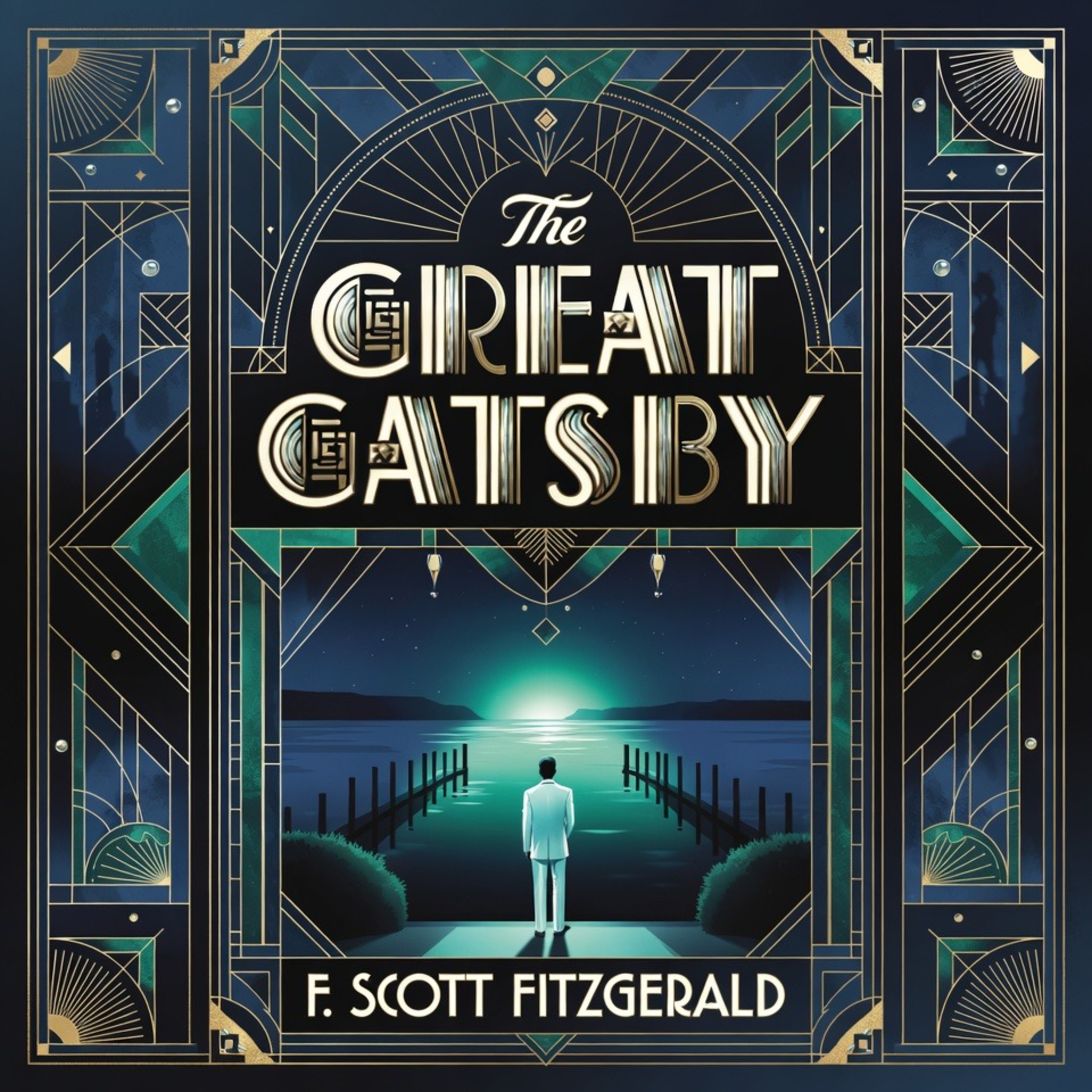
The Great Gatsby - Chapter Nine | Full Audiobook
The Story
This episode is sponsored by Wexley Pro, a professional, mobile-first book-production studio for iPhone.
Write, edit, format, and export complete books in EPUB, DOCX, and print-ready PDF formats, with local-first manuscript processing designed to keep your creative work under your control.
Discover Wexley Pro: https://wexley.pro
In Chapter 9 of The Great Gatsby, the world moves on. Gatsby is gone, and almost no one comes to bury him. Nick makes the phone calls nobody else will make, watches the city forget a man it consumed for an entire summer, and finally sees Tom and Daisy for exactly what they are — careless people who break things and disappear. This is Fitzgerald's last word on the American Dream: not a tragedy, not a warning, just a green light that was never really meant for you.
Chapter 9 | The Great Gatsby | F. Scott Fitzgerald | Classic Literature | Public Domain Audiobook | Chapter by Chapter
Welcome back to chapter by chapter, the audio book experience. We're continuing The Great Gatsby by F Scott Fitzgerald. If this is your first time here, start from the beginning of this season and follow Nick Carraway's story from the very start. And if you've been with us since chapter 8, welcome back. Gatsby is gone, the pool is quiet, and nobody came to the funeral. This is the chapter where Fitzgerald pulls all the way back and lets Nick reckon with everything he witnessed. The phone calls that don't get made, the father who arrives too late, the man who threw the greatest parties of the season, buried in the rain with almost no one there to see it.
Chapter 9 is the morning after, and it's the most honest chapter in the book. But before we close out this season, a quick word from our sponsor. Wexley Pro is a mobile first publishing studio that lets you write, format, and export professional epubs and PDFs directly from your phone with a provenance layer built in that verifies your authorship from the first keystroke. If you're a writer or IP creator who needs to prove their work is theirs, Early Access is open right now at app dot wexley dot pro.
And when this chapter wraps, we have something special coming. We're dropping the full Gatsby as one complete listen, start to finish, no breaks. And right behind it, the full Wuthering Heights in a single episode. Something to hold you over while we prepare what's coming next because next season we're doing a full Sherlock Holmes. Read through every story in order from the beginning, Follow the show so you don't miss any of it, and drop a comment with the classic you want us to read after homes.
Now sit back and let's finish the story, Chapter 9.
Two years later, I still recall the rest of that day, the night, and the following day as an endless parade of police, photographers and reporters streaming in and out of Gatsby's front door. A rope stretched across the main gate, wide eyed around the pool. Someone with a confident air, perhaps a detective, used the word madman as he leaned over Wilson's body that afternoon, and the authoritative tone of his voice set the narrative for the newspaper reports the next morning. Most of those reports were a nightmare, grotesque, circumstantial, eager and false.
When Michaelis testimony at the inquest revealed Bilsons suspicions about his wife, I expected the whole story to be spun into some sensational satire. But Catherine, who could have said anything, remained silent. She showed an unexpected strength of character, staring at the coroner with determined eyes beneath her carefully groomed brow. She swore that her sister had never met Gatsby, that her sister was completely happy with her husband, and that her sister had been involved in no wrongdoing whatsoever.
She convinced herself of this and wept into her handkerchief as if the mere suggestion was unbearable. And thus Wilson was portrayed as a man deranged by grief, so that the case could remain straightforward. And there it stayed. Yet all of this felt distant and irrelevant. I found myself standing by Gatsby's side, alone. From the moment I called West Egg Village with news of the catastrophe, every speculation about him, every practical question, was directed at me. Initially I was surprised and bewildered.
Then, as he lay in his house, unmoving, unbreathing, silent for hour upon hour, it dawned on me that I was responsible because no one else cared. Cared, I mean, with that deep personal concern to which everyone is vaguely entitled. At the end, I called Daisy half an hour after we found him, called her instinctively and without hesitation. But she and Tom had left earlier that afternoon, taking their luggage with them. Did they leave any address? No. Did they mention when they'd return? No. Do you have any clue where they may be?
How I could contact them? I don't know. I can't say I felt an urgent need to find someone for him. I wanted to step into the room where he lay and reassure him. I'll find someone for you, Gatsby. Don't worry. Just trust me, I'll get someone for you. Meyer Wolfscheme's name wasn't listed in the phone book. The Butler provided me with his office address on Broadway and I called information, but by the time I got the number, it was well past five and no one answered the phone. Could you try again? I've called three times.
It's really important. Sorry, I'm afraid no one's there. I returned to the drawing room and for a moment thought they were just random visitors, all these official people who suddenly filled the space. But even as they pulled back the sheet and stared at Gatsby with shocked eyes, his plea echoed in my mind. Listen, old sport, you've got to find someone for me. You've got to try hard. I can't face this alone. Someone began to question me, but I broke away and hurried upstairs, rifling through the unlocked parts of his desk.
He'd never explicitly told me his parents were gone, but there was nothing. Only the image of Dan Cody, a relic of forgotten turmoil, gazing down from the wall. The next morning, I dispatched the Butler to New York with a letter for Wolfsheim, seeking information and urging him to catch the next train. As I wrote it, the request felt unnecessary. I was sure he'd come once he saw the headlines, just as I was sure Daisy would send a telegram before noon. But neither a telegram nor Mr. Wolfsheim appeared.
Only more police photographers and reporters arrived. When the Butler returned with Wolf Sheem's reply, I began to feel a sense of defiance, a scornful unity between Gatsby and me against the world. Dear Mr. Carraway, this has been one of the most shocking events of my life. I can hardly believe it's true. Such a senseless act should make us all reflect. I cannot come down now as I am entangled in very important business and cannot get involved in this matter at present. If there is anything I can do later, let me know through a letter via Edgar.
I am utterly disoriented by news like this and completely overwhelmed. Yours truly, Meyer Wolfsheim and then a hurried postscript below. Let me know about the funeral, etcetera. I do not know his family at all. When the phone rang that afternoon and the operator said there was a call from Chicago, I thought it might finally be Daisy. But when the line connected, it was a man's voice, distant and faint. This is Slagle speaking. Yes. The name didn't ring a bell. Quite a mess, isn't it? Did you get my telegram?
There haven't been any telegrams. Young Parks in trouble. He said quickly. They nabbed him when he tried to cash the bonds just 5 minutes before they got a notice from New York with the serial numbers. Can you believe that? You never know with these small towns. Hello. I cut in, breathless. Listen, this isn't Mr. Gatsby. Mr. Gatsby's dead. There was a long pause on the other end, followed by a startled exclamation, then a sharp click as the line went dead. I believe it was on the third day when a telegram arrived, signed by Henry C Gatz from a town in Minnesota.
The message was brief. The sender was leaving immediately and requested the funeral be delayed until his arrival. It was Gatsby's father, a somber old man, overwhelmed and bewildered, wrapped in a long, inexpensive coat. Despite the warm September day, his eyes were constantly wet with emotion, and as I took his bag and umbrella, he tugged so persistently at his thin Gray beard that I struggled to help him out of his coat. He seemed on the verge of collapse, so I led him to the music room and had him sit while I arranged for some food.
But he refused to eat, and the glass of milk slipped from his trembling hand. I read about it in the Chicago newspaper. He said it was all over the Chicago newspaper. I left immediately. I didn't know how to contact you. His eyes, unfocused, roamed restlessly around the room. It was a madman, he said. He must have been insane. Would you like some coffee? I suggested gently. I don't want anything. I'm all right now, Mr. Caraway. Well, I'm all right now. Where have they taken Jimmy? I let him into the drawing room where his son lay and left him there.
A few young boys had gathered on the steps, peering into the hall. When I informed them of who had arrived, they dispersed reluctantly. After a short while Mr. Gatz emerged, his mouth slightly open, his face tinged with color, and his eyes shedding sporadic, untimely tears. He had reached an age where death no longer struck with a shocking blow, and as he surveyed the grandeur of the hall and the vast rooms branching into others, his sorrow mingled with a sense of reverent pride. I guided him to an upstairs bedroom.
As he removed his coat and vest, I explained that all arrangements had been postponed until his arrival. I wasn't sure what you'd prefer. Mr. Gatsby. Gats is my name. Mr. Gats. I thought you might want to take the body back West. He shook his head. Jimmy always preferred it here in the East. He ascended to his role in the East. Were you a friend of my son's? Mr. We were very close. He had a bright future ahead of him, you know. Just a young man, but with a sharp mind. He tapped his head meaningfully, and I nodded in agreement.
If he'd lived, he would have become a great man, someone like James J Hill. He would have contributed to building up the country. That's true, I replied, feeling uneasy. He fidgeted with the embroidered bedspread, attempting to pull it off, then lay down stiffly and fell asleep immediately. Later that night, a clearly nervous voice called, insisting on knowing my identity before revealing his own. This is Mr. Caraway, I answered. Oh. He sounded relieved. This is Clipspringer. I felt a sense of relief too, as it suggested another friend might attend Gatsby's funeral.
I didn't want it to become a public spectacle, so I had been reaching out to a few people myself. They were difficult to track down. The funeral is tomorrow at 3 here at the house. I'd appreciate it if you could let anyone who might be interested know. Oh, I will, he replied quickly. Though I doubt I'll run into anyone, but if I do. His tone made me wary. Of course you'll be there yourself. Well, I'll certainly try. What I actually called about is hold on, I interrupted. How about committing to coming?
Well, the truth is, I'm staying with some people up here in Greenwich, and they kind of expect me to be with them tomorrow. There is a picnic or something, but I'll do my best to get away. I let out an unguarded huh. And he must have heard it because he continued nervously. What I called about was a pair of shoes I left there. I wonder if it would be too much trouble to have the Butler send them over. They're tennis shoes and I'm sort of lost without them. My address is care of BF. I didn't catch the rest of the name because I hung up the phone.
After that. I felt a certain shame for Gatsby. 1 gentleman I called suggested he had gotten what he deserved. That was my mistake, for he was one of those who used to mock Gatsby with the boldness that came from drinking Gatsby's liquor, and I should have known better to reach out to him. On the morning of the funeral, I went to New York to find Meyer Wolfsheim. I couldn't seem to contact him any other way. Following the advice of an elevator boy, I pushed open a door labeled the Swastika Holding Company, and at first it seemed deserted.
But after I called out hello several times without response, an argument erupted behind a partition, and soon a striking Jewish woman appeared at an interior door, eyeing me with sharp, unfriendly eyes. There's nobody here. Mr. Wolfsheim's gone to Chicago. The first part was clearly a lie, as someone inside had started to whistle the rosary off. Key, Please tell him Mr. Carraway wants to see him. I can't bring him back from Chicago, can I? Just then, a voice unmistakably belonging to Wolfsheim called out Stella from the other side of the door.
Leave your name on the desk, she said quickly. And I'll give it to him when he returns, but I know he's there. She stepped closer, her hands moving indignantly up and down her hips. You young men think you can just barge in whenever you please? She scolded. We're fed up with it. When I say he's in Chicago, he's in Chicago. I mentioned Gatsby. Oh. She gave me another look. And what was your name? She disappeared. Moments later, Meyer Wolfsheim appeared solemnly in the doorway, extending both hands.
He led me into his office, speaking in a hushed tone about how it was a difficult time for all of us, and offered me a cigar. My memory goes back to when I first met him, a young major fresh out of the army, adorned with medals from the war. He was so strapped for cash that he had to keep wearing his uniform because he couldn't afford civilian quoes. The first time I saw him was when he walked into Winebrenner's pool room on 43rd St. looking for a job. He hadn't eaten in days. Come on, have some lunch with me, I said.
He devoured more than $4.00 worth of food in just half an hour. Did you help him get started in business? I asked. Help him, I made him. Oh, I lifted him from nothing, straight out of the gutter. I immediately recognized he was a well mannered young man and when he mentioned he was from Oxford, I knew he could be useful. I got him to join the American Legion and he quickly rose in their ranks right away. He did some work for a client of mine up in Albany. We were inseparable like this. He held up two thick fingers.
Always together. I wondered if their partnership included the infamous 1919 World Series scandal. Now he's gone, I said after a pause. You were his closest friend, so I assume you'll want to attend his funeral this afternoon. I'd like to come then come. The hair in his nostrils trembled slightly, and as he shook his head, his eyes welled with tears. I can't do it. I can't get involved, he said. There's nothing to get involved in. It's all over now. When a man gets killed, I never like to get involved in any way.
I keep my distance now. When I was younger, things were different. If a friend of mine passed away, regardless of the circumstances, I stayed by their side until the very end. You might call that sentimental, but I truly mean it to the bitter end. I realized he had his own reasons for not wanting to join, so I stood up. Did you go to college? He asked abruptly. For a moment I thought he might propose some kind of connection, but he simply nodded and shook my hand. We should learn to show our friendship to a man while he's alive, not just after he's gone.
He advised. After that, my own rule is to let everything be. When I left his office, the sky had darkened and I returned to West Egg in a light drizzle. After changing my clothes, I went next door and found Mr. Gatz pacing excitedly in the hallway. His pride in his son and his son's belongings was growing, and now he had something to show me. Jimmy sent me this picture. With trembling fingers, he pulled out his wallet. Look here it was, a photograph of the house, worn at the corners and smudged from many hands.
He eagerly pointed out every detail to me, his eyes searching mine for admiration. Look there, he exclaimed. He had shown it so many times that it seemed more real to him now than the house itself. Jimmy sent it to me. I think it's a very pretty picture. It really stands out. It does indeed. Have you seen him recently? He came to visit me two years ago and bought me the house I live in now. Of course, we were estranged when he ran away from home, but I understand now there was a reason for it. He knew he had a bright future ahead, and ever since he found success, he's been very generous with me.
He seemed hesitant to put the picture away, holding it for another moment, lingeringly before my eyes. Then he returned it to his wallet and pulled from his pocket a worn copy of a book titled Hop Along Cassidy. Look here. This is a book he had when he was a boy. It just goes to show you, doesn't it? It certainly does. Jimmy was determined to succeed. He always had resolutions like these or something similar. Do you see what he wrote about improving his mind? He was always keen on that. Once he told me I ate like a pig, and I punished him for that.
He hesitated to close the book, reading each entry aloud and then glancing eagerly at me. I think he half expected me to jot the list down for my own benefit. Just before 3:00, the Lutheran minister arrived from Flushing, and I found myself instinctively scanning the windows for more cars. Gatsby's father did the same. As time ticked by and the servants gathered waiting in the hallway, his eyes began to flutter with anxiety, and he spoke of the rain with a nervous uncertainty. The minister checked his watch repeatedly.
So I pulled him aside and asked him to wait another 30 minutes. But it was futile. No one else came. Around 5 are small procession of three cars reached the cemetery, halting in a dense drizzle by the gate. A motor hearse, ominously black and glistening with rain, led the way, followed by Mr. Gatz, the minister and me in the limousine. A short while later, four or five servants and the postman from West Egg arrived in Gatsby's station wagon, all drenched to the bone. As we moved through the cemetery gate, I heard a car pull up and then the sound of someone splashing through the wet ground behind us.
I turned to see who it was. It was the man with owl eyed glasses whom I had once found marveling at Gatsby's books in the library 3 months earlier. I hadn't seen him since that night. I had no idea how he learned about the funeral, nor did I know his name. Rain streamed down his thick lenses and he removed them to wipe them clean, trying to see the canvas being unfurled over Gatsby's grave. I tried to think about Gatsby for a moment, but he already felt distant, and I could only recall without bitterness that Daisy hadn't sent a message or even a flower.
Faintly, I heard someone murmur. Blessed are the dead that the rain falls on. And then the allied man echoed. Amen to that. With a voice full of courage, we hurried through the rain to the cars. Allies spoke to me at the gate. I couldn't get to the house, he mentioned. Neither could anyone else. Go on, he exclaimed, startled. Why, my God, they used to flock there by the hundreds. He removed his glasses and wiped them again, both sides. The poor son of a bitch, he said. One of my most vivid memories is returning to the West from prep school and later from college.
During Christmas, those traveling beyond Chicago would gather in the old dim Union Station at 6:00 on a December evening with a few Chicago friends already swept up in their own holiday celebrations to bid them a quick farewell. I recall the fur coats of the girls returning from Miss This Or That's their breath visible in the cold air, and the animated gestures. As we recognized familiar faces, we exchanged invitations. Are you going to the Ordways? The Hersys? The Schultzes. Clutching long green tickets in our gloved hands, we stood ready.
Finally, the murky yellow cars of the Chicago, Milwaukee and Saint Paul Railroad appeared, as festive as Christmas itself, waiting on the tracks by the gate. As we ventured into the winter night, our snow began to unfurl alongside us, sparkling against the train windows. The dim lights of small Wisconsin stations slipped by and a sharp, invigorating chill filled the air. We inhaled deeply as we walked back from dinner through the cold vestibules, acutely aware of our connection to this land for one strange hour before we dissolved back into it.
That's my middle W. Not the wheat fields or the prairies or the forgotten Swede towns, but the exhilarating return of trains for my youth, the street lamps and sleigh bells and the frosty darkness and the shadows of holly wreaths cast by illuminated windows on the snow. I am part of that, a bit solemn from the long winters, a bit self satisfied from growing up in the caraway house in a city where homes are still known by family names through the decades. I realize now that this has been a story of the West.
After all, Tom, Gatsby, Daisy and Jordan and I were all Westerners, perhaps sharing some subtle flaw that made us I'll suited to Eastern life. Even when the East thrilled me most, even when I was most aware of its superiority over the monotonous, sprawling towns beyond the Ohio, with their endless interrogations sparing only the young and the very old. Even then, it always seemed distorted to me. West Egg in particular, still appears in my more fantastical dreams. I envision it as an El Greco night scene, 100 houses, both traditional and bizarre, huddled beneath a brooding, oppressive sky and a dull moon in the foreground.
4 solemn men in formal suits walk along the sidewalk carrying a stretcher with a drunken woman in a white evening gown. Her hand, dangling over the edge, glitters coldly with jewels. The men with grave expressions turn into a house, the wrong house, but no one knows her name and no one cares. After Gatsby's death, the East became a haunting place for me, warped beyond what my eyes could adjust to. So when the air was filled with the blue smoke of brittle leaves and the wind stiffened the wet laundry on the line, I decided to return home.
There was 1 task to complete before I left, an awkward, unpleasant duty that perhaps should have been ignored. But I wanted to leave things tidy, not just rely on the obliging, indifferent sea to wash away my debris. I met with Jordan Baker and we talked around and through what had happened between US and what had happened to me. Afterward she sat perfectly still, listening in a large chair. She was dressed for golf, and I remember thinking she looked like a fine illustration, her chin slightly raised with a jaunty air, her hair the color of an autumn leaf, her face the same brown shade as the fingerless glove on her knee.
When I finished, she told me without comment that she was engaged to another man. I doubted it, though there were several she could have married with a mere nod, but I feigned surprise for a moment. Doubt crept in, making me question my decision, but I quickly reconsidered and rose to say my goodbyes. Still, you did leave me hanging. Jordan interjected suddenly. You ended things over the phone. I don't care about you now, but it was a novel experience for me, and it left me a big shaken for a while.
We shook hands. Oh, and do you remember? She added that talk we had once about driving. Why not exactly? You said a bad driver is only safe until they encounter another bad driver, right? Well, I met another bad driver, didn't I? It was careless of me to misjudge so badly. I thought you were honest and straightforward. I thought that was your hidden pride. I'm 30. I'm five years too old to deceive myself and call it honor. She said nothing. Angry, half in love with her, and deeply regretful, I turned away.
One afternoon in late October, I ran into Tom Buchanan. He was striding ahead of me along 5th Ave. moving with a sharp, assertive energy. His hands were slightly away from his sides, as if ready to fend off any obstacles, while his head darted around, aligning with his restless gaze. Just as I slowed my pace to avoid catching up to him, he paused, frowning at the display of a jewelry store. Suddenly, he noticed me and walked back, extending his hand. What's wrong, Nick, are you refusing to shake hands with me?
Yes, you know exactly how I feel about you. You're out of your mind, Nick. He shot back quickly. Completely out of your mind. I don't understand what's gotten into you, Tom, I pressed. What did you say to Wilson that afternoon? He looked at me silently, and I knew I had pieced together those missing hours correctly. I began to turn away, but he stepped forward and grabbed my arm. I told him the truth, he admitted. He showed up at the door while we were getting ready to leave, and when I sent word down that we weren't available, he forced his way upstairs.
He was mad enough to kill me if I hadn't told him who owned the car. His hand was on a revolver in his pocket every moment he was in the house, he said defiantly. So what if I told him that guy had it coming? He fooled you just like he fooled Daisy. But he was a hard man. He ran over Myrtle like you'd run over a stray dog and didn't even stop the car. There was nothing I could say except for the one undeniable truth that it wasn't so. And if you think I didn't suffer my share, listen. When I went to give up that apartment and saw that damn box of dog biscuits on the sideboard, I sat down and cried like a child.
By God, it was terrible. I couldn't forgive him or like him, but I understood that to him, his actions were completely justified. It was all so careless and confused. Tom and Daisy were careless people. They destroyed things and lives and then retreated into their wealth or their vast indifference, or whatever it was that held them together, leaving others to clean up their mess. I shook his hand. It seemed foolish not to, as I suddenly felt as though I were speaking to a child. Then he went into the jewelry store to buy a Pearl necklace, or maybe just a pair of cufflinks.
Free of my provincial squeamishness forever, Gatsby's house was still empty when I left. The grass on his lawn had grown as long as mine. One of the taxi drivers in the village never passed the entrance gate without stopping for a moment and pointing inside. Maybe he was the one who drove Daisy and Gatsby to East Egg the night of the accident, and perhaps he had crafted his own story about it. I didn't want to hear it, and I avoided him when I got off the train. I spent my Saturday nights in New York, the memory of those brilliant, dazzling parties still vivid in my mind.
I could almost hear the music and laughter, faint yet persistent, drifting from his garden, and the sound of cars coming and going along his driveway. One night I actually heard a real car and saw its headlights pause at his front steps, but I didn't go to see who it was. Likely it was a final guest returned from some distant corner of the earth, unaware that the party had ended. On the last night, with my bags packed and my car sold to the grocer, I went back to look at that vast, incoherent failure of a house one more time.
On the white steps, an obscene word scrawled by some boy with a piece of brick stood out clearly in the moonlight. I erased it, dragging my shoe harshly across the stone. Then I wandered down to the beach and lay sprawled on the sand. Most of the grand shore houses were closed now, and there were hardly any lights except for the shadowy moving glow of a ferryboat crossing the sound. As the moon climbed higher, the unnecessary houses began to dissolve, until gradually I became aware of the old island here that once bloomed for the eyes of Dutch sailors, a fresh green breast of the New World.
The vanished trees, the ones that had made way for Gatsby's house, had once whispered to the last and greatest of all human dreams. For a fleeting, enchanted moment, humanity must have held its breath in the presence of this continent, drawn into an aesthetic contemplation it neither understood nor wanted, face to face, for the last time in history, with something equal to its capacity for wonder. As I sat there, lost in thought about the old, unknown world, I considered Gatsby's wonder when he first noticed the green light at the end of Daisy's dock.
He had traveled a long way to this blue lawn, and his dream must have seemed so close that he could hardly fail to grasp it. He was unaware that it was already left behind, somewhere in the immense darkness beyond the city, where the shadowy fields of the Republic stretched endlessly under the night sky. Gatsby had faith in the green light, the ecstatic future that perpetually slips further away. It escaped us then, but that doesn't matter. Tomorrow we will strive harder, reach out further. And one fine morning.
Thus we continue like boats against the current, relentlessly driven back into the past. And that's where Fitzgerald leaves us, Nick alone on the beach at night, tracing the old unknown world with his finger in the dark boats against the current, borne back ceaselessly into the past. Chapter 9 is the exhale, the funeral nobody came to, the phone calls that didn't happen. Henry Gatz arriving with a photograph and a pride his son spent his whole life running from. Fitzgerald doesn't let anyone off easy here.
Not Tom, not Daisy, not the city that consumed Gatsby and moved on without a second thought. A few things worth sitting with as you go. Think about who shows up to the funeral. One man, Owl eyes. The stranger from the library who noticed the books were real. Of all the hundreds who filled that house every weekend, drinking his liquor and feeding on his hospitality, only one person bothers to come and stand in the rain. That detail says everything Fitzgerald never says directly. And then there's Nick's final confrontation with tom-tom, who is breezy and unapologetic, who has already moved on.
He genuinely doesn't understand what he did wrong. That's the novels coldest note. Not the violence, not the abandonment, but the complete absence of weight in the people who caused it all. But the image that stays is that last one. Nick on the shore, the green light gone dark. Understanding for the first time what Gatsby must have known all along. That the dream was never really ahead of him. It was always already behind. This episode was sponsored by Wexley Pro, the mobile first publishing studio where writers own their work from the first word to the final export.
Early access is open at App dot Wexley dot pro. We'll see you there. And we'll see you in our Sherlock Holmes run. Thanks for listening.
 Apple Podcasts
 Castbox
 Castro
 Goodpods
 Moon FM
 Overcast
 Pocket Casts
 Podbean
 Podcast Addict
 Podcast Republic
 Spotify