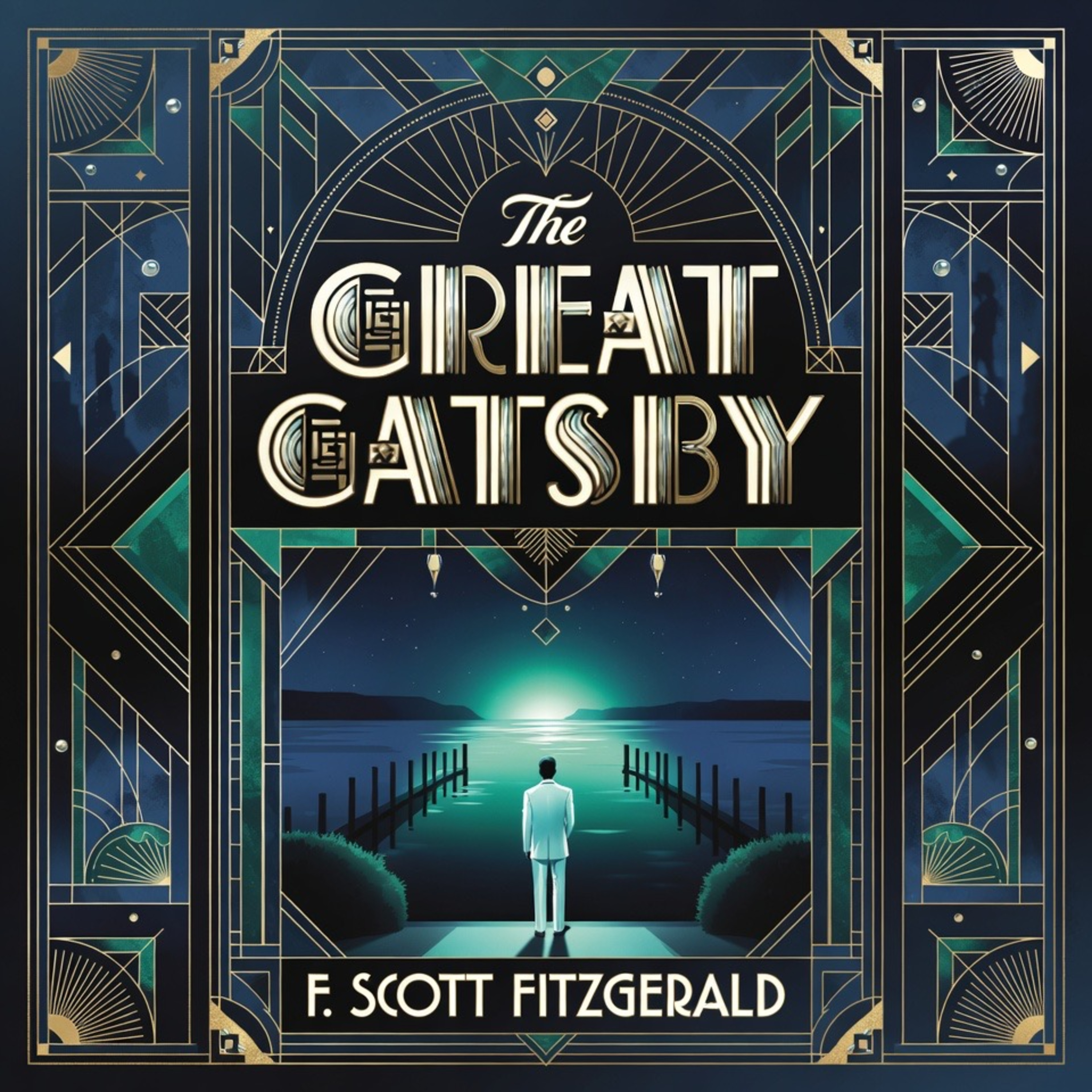
The Great Gatsby - Chapter Four | Full Audiobook
The Story
This episode is sponsored by Wexley Pro, a professional, mobile-first book-production studio for iPhone.
Write, edit, format, and export complete books in EPUB, DOCX, and print-ready PDF formats, with local-first manuscript processing designed to keep your creative work under your control.
Discover Wexley Pro: https://wexley.pro
In Chapter Four, Gatsby takes Nick for a drive into the city and delivers his carefully rehearsed life story — wealthy Midwestern family, Oxford education, war medals, European adventure. Nick almost believes it. Almost. Over lunch, we meet Meyer Wolfshiem, the man who fixed the 1919 World Series, and suddenly the glamour around Gatsby gets a lot more complicated. Then Jordan Baker finally tells Nick the truth. The mansion, the parties, the green light across the water — none of it was ever about wealth or status. It was always about one person. Gatsby bought that house so he could see Daisy's light from his lawn. And now he's asking Nick to bring her back to him. Five years of waiting. One afternoon of tea. And nothing about Jay Gatsby is simple. Follow the show so you never miss a chapter, and drop a comment with the classic you want us to read next — your suggestion could become our next season.
Welcome back to chapter by Chapter, the audio book experience. We're continuing The Great Gatsby by F Scott Fitzgerald. If this is your first time here, start from the beginning of this season and follow Nick Carraway's story from the very start. And if you've been with us since Chapter 3, welcome back. We've been inside the party. We've met Gatsby face to face, charming, composed and full of carefully chosen words. Now, the morning after has come and gone, and Nick is starting to ask the question everyone around Gatsby eventually asks.
Who is he really? Follow the show so you never miss a chapter and drop a comment with the classic you want us to read next. Now sit back and let's continue the story. Chapter 4.
On Sunday morning, as church bells chimed in the villages along the shore, the world and its mistress returned to Gatsby's estate, sparkling with laughter across his lawn. He's a bootlegger, the young women said, drifting between his cocktails and his flowers. Once he killed a man who discovered he was related to von Hindenburg and a second cousin to the devil. Pass me a rose, darling, and pour me one last drop into that crystal glass. Once I scribbled the names of those who visited Gatsby's house that summer on the blank spaces of a timetable.
It's an old timetable now, crumbling at the creases marked with this schedule in effect July 5th, 1922. Yet I can still make out the faded names, and they offer a clearer picture than my vague descriptions of those who enjoyed Gatsby's hospitality, all while remaining blissfully ignorant of the man himself. From East Egg arrived the Chester Beckers and the Leeches, along with a man named Bunsen, whom I knew from Yale, and Doctor Webster Civet, who drowned last summer in Maine. There were the Horn Beams and the Willy Voltaires and an entire clan called the Blackbucks, who always huddled in a corner lifting their noses like goats at anyone who approached the ismays and the Christies were there too, or rather Hubert Auerbach and Mr. Christie's wife, and Edgar Beaver, whose hair, they say, inexplicably turned cotton white.
1 winter afternoon, I recall Clarence Endive from East Egg. He attended only once, dressed in white knickerbockers, and ended up in a brawl with a vagrant named Eddie in the garden. From further out on the island came the Cheadles and the ORP Schraders, along with the Stonewall, Jackson Abrams from Georgia and the fish guards and Ripley Snell. Snell was present three days before he landed in the Penicentiary, so inebriated on the gravel drive that Mrs. Ulysses Sweat's car ran over his right hand.
The Danceies were there, along with SB Whitebait, who was well past 60. Maurice A Flink, the Hammerheads, and Beluga the tobacco importer, accompanied by Beluga's entourage from West Egg, arrived the Poles, the Mole Readies, Cecil Roebuck, Cecil Shone, Gulick the State Senator, and Newton Orchid, who had a grip on film's par excellence. Eckhaus Clyde Cohen, Don S Schwartz, the son, and Arthur McCarty were all tied to the film industry in various ways. The Cat Lips, the Bem Bergs, and G Earl Muldoon, brother of the infamous Muldoon who later strangled his wife, also made an appearance.
Da Fontano, the promoter, showed up, as did Ed La Gross, James B Rotgut, Ferret, the Jungs, and Ernest Lily, all there to gamble. When Ferret drifted into the garden, it signaled he was broke and associated traction would need to perform well the next day. A man named Clipspringer was such a regular presence that he earned the nickname The Border. I doubt he had another place to call home. Among the theatrical crowd were Gus Ways, Horace O'donovan, Lester Meyer, George Duckweed and Francis Bull.
From New York came the Chromes, the Back Hissens, the Deneckers, Russell Betty, the Corrigans, the Kelleher's, the Doers, the Scullys, SW Belcher, the Smirks, the young Quins, now divorced, and Henry L Palmetto, who ended his life by leaping in front of a subway train at Times Square. Benny Mcclenaghan always arrived with four women in tow. Though they were never exactly the same individuals, they were so strikingly similar that it felt as if they had been there before. Their names escape me perhaps Jacqueline, or maybe Consuela, Gloria, Junie, or June.
Their surnames were either the lyrical kind, reminiscent of Flowers and Months, or the formidable ones of prominent American industrialists, whom they might admit to being related to if pressed among the crowd. I distinctly recall Faustina O'Brien making an appearance at least once, as well as the Baedeker sisters, young Brewer who had lost his nose in the war, Mr. Albrochtsberger and his fiancee, Miss Hogg, Ardita Fitzpaters, Mr. P Jewett, a former leader of the American Legion, and Miss Claudia Hip, accompanied by a man rumored to be her chauffeur.
There was also a Prince of some kind whom we referred to as Duke, but his real name, if I ever knew it, has slipped my mind. All these people gathered at Gatsby's estate during the summer.
One morning in late July, at precisely 9:00, Gatsby's magnificent car rumbled up the rocky drive to my door, announcing its arrival with a melodic blast from its three toned horn. This was the first time he had personally visited me, despite my attendance at two of his parties, my rides on his hydroplane, and my frequent enjoyment of his beach at his insistent invitation. Good morning, old sport. You're joining me for lunch today, and I thought we could drive together. He was perched on the dashboard of his car with that uniquely American agility, A fluidity borne, I suspect, from a youth devoid of heavy labor and shaped instead by our erratic, energetic sports.
This restless energy constantly seeped through his otherwise meticulous demeanor. He was never entirely still. There was always a foot tapping or a hand opening and closing. With impatience, he noticed. I admired his car. Isn't it something old sport? He hopped off to give me a clearer view. Haven't you seen it before? I had. Everyone had. It was a creamy masterpiece, gleaming with nickel, it's extravagant length bulging with opulent hat boxes, supper boxes and tool boxes, and layered with a maze of windshields reflecting a dozen Suns.
Settling into the green leather cocoon behind multiple panes of glass, we headed into town. Over the past month, I'd spoken with him maybe half a dozen times and to my disappointment, found he had little to say. My initial impression of him as a man of some vague significance had gradually diminished, leaving him merely as the owner of the elaborate Roadhouse next door. Then came that unsettling Dr. We hadn't even reached West Egg Village when Gatsby started leaving, his polished sentences hanging in the air, tapping his knee uncertainly through the fabric of his caramel colored suit.
Listen, old sport. He suddenly burst out. What do you really think of me? Caught off guard, I began offering the usual vague responses such a question demands. Well, I'm going to tell you something about my life. He cut in. I don't want you to get the wrong impression from all these stories you hear. So he was aware of the strange rumors that swirled through his own gatherings. I'll tell you the honest truth. His right hand seemed to summon divine judgement to bear witness. I come from wealthy people in the Midwest.
All of them are gone now. I was raised in America but educated at Oxford because my ancestors have been going there for generations. It's a family tradition. He glanced at me sideways, and I understood why Jordan Baker thought he was lying. He rushed through Educated at Oxford, or swallowed it, or choked on it, as if it had troubled him before. With that doubt, his whole story unravelled, and I began to wonder if there wasn't something a bit sinister about him after all. What part of the Midwest?
I asked, trying to sound nonchalant. San Francisco. I see my whole family passed away, and I inherited A substantial amount of money. His voice carried a weight, as if the memory of losing his family still lingered heavily. For a moment I thought he might be joking, but one look at him dispelled that notion. After that, I lived like a young Prince across Europe's capitals, Paris, Venice, Rome, collecting jewels, mostly rubies, going on big game hunts, dabbling and painting, all for my own pleasure while trying to forget something deeply sorrowful from my past.
I barely managed to suppress a laugh of disbelief. His words were so cliche that they conjured nothing but the image of a cartoonish figure turbaned in leaking sawdust, chasing a tiger through the Bois de Boulogne. Then the war came, old sport. It was a welcome distraction, and I tried earnestly to die, but I seemed to lead a charmed life. I took a Commission as a first Lieutenant at the start in the Argonne Forest. I LED what was left of my machine gun battalion so far ahead that there was a half mile on either side where the infantry couldn't keep up.
We held our ground for two days and two nights, 130 men with 16 Lewis guns. And when the infantry finally caught up, they found the Insignia of three German divisions among the dead. I was promoted to major, and every Allied nation awarded me a decoration, even Montenegro. Little Montenegro on the Adriatic Sea. Little Montenegro. He lifted the words as if they were a toast, nodding with a smile that understood Montenegro's turbulent past and empathized with the courageous struggles of its people.
His smile fully grasped the series of national events that had inspired this tribute from Montenegro's passionate heart. My skepticism was now overwhelmed by fascination. It felt like Quickly flipping through a dozen magazines, he reached into his pocket and a piece of metal hanging from a ribbon dropped into my hand. That's the one from Montenegro. To my surprise, it looked genuine. Orderee de Denilo Montenegro. Nicholas Rex, Turn it over. Major Jay Gatsby for valor. Extraordinary. Here's something else.
I always carry a memento from my Oxford days. It was taken in Trinity Quad. The man on my left is now the Earl of Doncaster. It was a photograph of a half dozen young men in Blazers lounging in an archway beyond which a multitude of Spires could be seen. There was Gatsby, looking slightly but not much younger, with a cricket bat in his hand. Then it was all true. I saw the tiger skins blazing like fire in his palace on the Grand Canal. I watched him open a chest of rubies, their deep Crimson glow a balm for the relentless ache of his shattered heart.
I'm going to ask something significant of you today. He said, tucking away his mementos with a sense of satisfaction. So I thought you should know a bit about me. I didn't want you to think I was just some nobody. You see, I often find myself among strangers because I wander from place to place, trying to forget the sorrowful events of my past. He paused. You'll hear about it this afternoon at lunch. No, this afternoon I happen to learn that you're taking Miss Baker to tea. Are you saying you're in love with Miss Baker?
No. Old sports, I'm not. But Miss Baker has kindly agreed to talk to you about this matter. I had no clue what this matter was, and I was more irritated than intrigued. I hadn't invited Jordan to tea to discuss Mr. J Gatsby. I was sure the request would be something utterly outlandish, and for a moment I regretted ever stepping on to his crowded lawn. He fell silent, his sense of propriety intensifying as we approached the city. We passed Port Roosevelt, catching a glimpse of ocean going ships with their distinctive red belts and speed through a cobbled slung lined with the dim, still occupied salons of the faded gilt early 1900s.
Then the valley of ashes unfurled on either side of us, and I caught sight of Missus Wilson, her energy palpable as she strained at the garage pump. As we drove by with fenders flared like wings, we cast light across half of Astoria. Only half, because as we wove through the pillars of the elevated train, I heard the familiar jug jug spat of a motorcycle, and a frantic policeman pulled up alongside us. All right, old sport. Gatsby called out. We slowed down. He took a white card from his wallet and flashed it before the officer's eyes.
Right you are, The officer agreed, tipping his cap. Pardon me, what was that? I asked. The picture of Oxford. I once did the commissioner a favor, and now he sends me a Christmas card every year. We crossed the great bridge, sunlight flickering through the girders on the moving cars, with the city rising across the river like white mounds and sugar cubes, all conjured from money that doesn't smell. The view from the Queensboro Bridge always feels like seeing the city for the first time, with its wild promise of all the world's mystery and beauty.
A hearse carrying a dead man past us, piled high with flowers, followed by two carriages with drawn blinds, and then by more lively carriages for friends. The friends peered out at us with the tragic eyes and short upper lips typical of southeastern Europe, and I was pleased that Gatsby's magnificent car was part of their somber procession. As we crossed Blackwell's Island, a limousine passed us, driven by a white chauffeur with three stylish black passengers inside, two men and a woman. I laughed out loud as their eyes rolled toward us in proud defiance.
Anything can happen now that we've crossed this bridge, I thought. Anything at all, even Gatsby, could happen without any particular surprise. It was a blazing noon in a cool, well ventilated cellar on 42nd Street. I met Gatsby for lunch. Blinking away the brightness from outside, I spotted him in the dim ante room, engaged in conversation with another man. Mr. Carraway, meet my friend. Mr. Wolfsheim. A small man with a flat nose lifted his large head to look at me, his nostrils adorned with two impressive Tufts of hair.
It took a moment for me to find his tiny eyes in the dim light, so I took one look at him. Mr. Wolfsheim said, shaking my hand with earnestness. And guess what? I did what? I asked politely, but it seemed he wasn't speaking to me as he let go of my hand and turned his attention to Gatsby with his expressive nose. I handed the money to Kat's bow and said, all right, Kat's bow, don't give him a cent until he keeps quiet. And he did, right then and there. Gatsby took hold of both our arms and LED us into the restaurant, causing Mr. Wolfsheim to swallow the sentence he was about to start and drift into a dreamy silence.
Highballs. The head waiter inquired. This place is nice, Mr. Wolfsheim remarked, gazing at the Presbyterian nymphs painted on the ceiling. But I prefer the place across the street. Yes, highballs, Gatsby agreed, then turned to Mr. Wolfsheim. It's too hot over there. Hot and cramped, yes, but it's full of memories. What place is that? I inquired. The old metropole. The old metropole, Mr. Wolfsheim repeated, his voice heavy with nostalgia. It's filled with faces that are no more, filled with friends who are gone forever.
I can't forget as long as I live. The night they shot Rosie Rosenthal there. There were six of us at the table, and Rosie had been eating and drinking all evening. When it was nearly morning, the waiter approached him with a strange expression and said someone wanted to speak to him outside. All right, Rosie said, starting to rise, but I pulled him back into his chair. Let them come in here if they want you, Rosie, but don't you dare step outside this room. It was 4 in the morning then, and if we'd raised the blinds we'd have seen the first light of day.
Did he go? I asked, feigning innocence. Of course he went. Mr. Wolfsheim's nose flared with indignation. He turned at the door and said don't let that waiter take my coffee. Then he stepped onto the sidewalk and they shot him three times in the stomach before driving off. 4 of them were executed, five including Becker, he corrected, his nostrils flaring with interest. As you looked at me, I hear you're seeking a business connection. The contrast between these statements was jarring. Gatsby spoke up for me.
Oh no, he said quickly. This isn't the man. No, Mr. Wolfsheim seemed let down. This is just a friend I mentioned. We discussed that another time. My apologies, Mr. Wolfsheim said. I mistook you for someone else. A rich hash was served, and Mr. Wolfsheim, momentarily setting aside the nostalgic air of the old metropole, began to eat with a kind of fierce delicacy. His eyes wandered slowly around the room, completing a full circle as he turned to scrutinize the people directly behind us. I suspect that if I hadn't been there, he might have taken a quick peek under our table.
Listen, old sport, Gatsby said, leaning in closer. I worry I might have upset you earlier in the car. His smile reappeared, but this time I resisted its charm. I don't like mysteries, I replied. And I can't understand why you won't just be straightforward and tell me what you want. Why does everything have to go through Miss Baker? Oh, there's nothing shady about it, he reassured me. Miss Baker's a real sport, you know, and she'd never do anything improper. Suddenly he checked his watch, sprang up and rushed out of the room, leaving me alone with Mr. Wolfsheim at the table.
He needs to make a call, Mr. Wolfsheim explained, watching him leave. A fine fellow, isn't he? Handsome and a true gentleman? Yes, he's an Oxford man. Oh, he attended Oxford College in England. Are you familiar with Oxford College? I've heard of it. It's one of the most renowned colleges in the world. Have you known Gatsby for a long time? I asked. For several years. He replied with a sense of satisfaction. I had the pleasure of meeting him just after the war, but I knew right away I had encountered a man of true refinement.
After just an hour of conversation, I thought to myself, here's the kind of man you'd want to bring home to meet your mother and sister. He paused. I noticed you're looking at my cufflinks. I hadn't been, but now I did. They were made of strangely familiar pieces of ivory. Finest specimens of human molars, he told me. Well, I examined them. That's a very intriguing concept. Yes. He tucked his sleeves back under his coat. Yes, Gatsby is very particular about women. He would never even glance at a friend's wife.
When the man who was the subject of this innate trust returned to the table and sat down, Mr. Wolfsheim finished his coffee abruptly and stood up. I've enjoyed my lunch, he declared. And I'm going to leave you two young men before I overstay my welcome. Don't rush off, Meyer Gatsby said, though without much enthusiasm. Mr. Wolfsheim lifted his hand in a kind of blessing. You're very kind, but I belong to a different era, he stated solemnly. You sit here and talk about your sports and your young women and your.
He gestured with his hand, filling in an imaginary word. As for me, I'm 50 years old and I won't impose on you any longer. As he shook hands and turned away, his sorrowful nose quivered. I wondered if I had inadvertently offended him. He gets very sentimental sometimes, Gatsby explained. Today is one of those sentimental days. He's quite a figure in New York, a fixture on Broadway. Who is he, anyway? An actor? No, a dentist? Meyer Wolfsheim? No, he's a gambler. Gatsby paused, then added with a cool detachment.
He's the one who rigged the World Series back in 1919. Rigged the World Series? I echoed. The notion left me reeling. I recalled, naturally, that the World Series had been rigged in 1919. But if I had ever considered it, I thought of it as something that just happened, the conclusion of some unavoidable sequence. It never crossed my mind that a single person could manipulate the trust of 50 million people with the precision and intent of a burglar cracking a safe. How did he manage that? I asked after a moment.
He simply recognized the opportunity. Why isn't he in prison? Gatsby asked. They can't touch him, old sport. He's too clever. I insisted on settling the bill. As the waiter returned with my change, I noticed Tom Buchanan across the bustling room. Come with me for a moment, I need to greet someone. Upon seeing us, Tom sprang up and took several steps in our direction. Where have you been? He asked eagerly. Daisy's furious because you haven't called. This is Mr. Gatsby, Mr. Buchanan. They shook hands briefly, and an awkward, unfamiliar look of embarrassment crossed Gatsby's face.
How have you been, anyway? What brings you all the way up here for a meal? I've been having lunch with Mr. Gatsby. I turned to look at Mr. Gatsby, but he had already disappeared. 1 October day in 1917. Jordan Baker recounted that afternoon, sitting up very straight on a stiff chair in the tea garden at the Plaza. I was wandering from one place to another, partly on the sidewalks and partly on the lawns. I preferred the lawns because I wore shoes from England with rubber knobs on the soles that gripped the soft earth.
I also had on a new Plaid skirt that fluttered a bit in the breeze, and whenever it did, the red, white and blue banners in front of all the houses would stretch out stiffly and seem to tut, tut, tut, tut, tut in disapproval. The largest of the banners and the most expansive lawn belonged to Daisy Faye's house. She was just 18-2 years older than me and by far the most popular young woman in Louisville. She dressed in white, drove a little white roadster, and all day long the phone rang in her house with eager young officers from Camp Taylor vying for the chance to spend the evening with her.
Anyway, for an hour that morning, as I came across from her house, her white roadster was parked by the curb. She was in it, sitting with a Lieutenant I had never seen before. They were so absorbed in each other that she didn't notice me until I was just five feet away. Hello, Jordan. She called out unexpectedly. Please come here. I felt flattered that she wanted to talk to me because among all the older girls, she was the one I admired the most. She asked if I was heading to the Red Cross to make bandages.
I was. Then she asked if I could tell them she wouldn't be able to make it that day. The officer looked at Daisy as she spoke. In a way, every young girl dreams of being looked at at least once, and because it seemed so romantic to me, I've remembered that moment ever since. His name was Jay Gatsby and I didn't see him again for over 4 years. Even after meeting him on Long Island, I didn't realize he was the same man. That was in 1917. By the following year, I had a few suitors of my own and started playing in tournaments, so I didn't see Daisy often.
She mingled with a slightly older crowd when she went out at all. Wild rumors swirled about her, how her mother had caught her packing her bag 1 winter night to go to New York and say goodbye to a soldier heading overseas. She was effectively stopped, but she didn't speak to her family for several weeks after that. She stopped flirting with the soldiers and instead spent time with a few young men in town who were flat footed and shortsighted, unable to join the army at all. By the following autumn, her spirits had lifted and she was as lively as ever.
She made her social debut after the Armistice, and by February she was reportedly engaged to a man from New Orleans. In June, she married Tom Buchanan from Chicago, with a grandeur that Louisville had never witnessed before. He arrived with 100 guests in four private rail cars, rented an entire floor of the Muhlbach Hotel, and the day before the wedding he gifted her a Pearl necklace worth $350,000. I was one of her bridesmaids. I entered her room half an hour before the bridal dinner and found her lying on her bed, as enchanting as a June knight in her floral dress and as drunk as a sailor.
She held a bottle of Saturn in one hand and a letter in the other. Congratulate me, she slurred. Never had a drink before, but oh, how I do enjoy it. What's wrong, Daisy? I was frightened. I must admit. I had never seen a girl in such a state before here deeries she fumble around in a wastebasket she had on the bed with her and pulled out the string of pearls. Take them downstairs and return them to whoever they belong to. Tell them daisies changed her mind. Say daisies changed her mind. She began to cry.
Tears flowed endlessly. I hurried out to find her mother's maid, and together we locked the door and got her into a cold bath. She clung to the letter, taking it into the tub with her, squeezing it into a wet ball, and only allowed me to leave it in the soap dish when she saw it disintegrating like snow. But she didn't utter another word. We gave her spirits of ammonia, placed ice on her forehead, and fastened her back into her dress. Half an hour later when we stepped out of the room, the pearls were around her neck and the incident was over.
The next day at 5:00, she married Tom Buchanan without a tremor and embarked on a three month trip to the South Seas. I saw them in Santa Barbara when they returned, and I thought I'd never seen a girl so infatuated with her husband. If he left the room for even a moment, she'd glance around uneasily and ask where's Tom gone, wearing the most distracted expression until she saw him reenter. She would sit on the sand with his head in her lap for hours, gently tracing her fingers over his eyes and gazing at him with unfathomable delight.
It was touching to see them together. It made you laugh in a quiet, captivated way. And that was in August, a week after I left Santa Barbara. Tom had an accident on the Ventura Road one night, crashing into a wagon and tearing a front wheel off his car. The girl with him made the news as well. Her arm was broken. She was one of the chambermaids from the Santa Barbara Hotel. Then, about six weeks ago, she heard Gatsby's name for the first time in years. It was when I asked you, Do you remember if you knew Gatsby and West Egg?
After you left, she came into my room, woke me up and asked what Gatsby. When I described him, still half asleep, she said in the most peculiar voice that it must be the man she once knew. It wasn't until that moment that I realized this Gatsby was the same officer who had once been in her white car. After Jordan Baker had finished recounting everything, we had left the Plaza for about 30 minutes and we're now riding in a Victoria through Central Park. The sun had dipped behind the towering apartments of the movie stars in the West 50s, and the clear voices of children already gathered like crickets on the grass, floated up through the warm twilight.
I'm the Sheikh of Arabi. Your love belongs to me. At night, when you're asleep into your tent aisle creep. It was a strange coincidence, I remarked, but it wasn't a coincidence at all. Why not? Gatsby bought that house so Daisy would be just across the Bay. So it hadn't been merely the stars he reached for on that June night. He became real to me then, suddenly emerging from the womb of his aimless grandeur. He wants to know, Jordan continued. If you'll invite Daisy to your house some afternoon and then let him come over.
The simplicity of the request startled me. He had waited five years and purchased a mansion where he scattered Starlight to passing moths just so he could come over one afternoon to a stranger's garden. Did I have to know all this before he could ask such a small favor? He's nervous, having waited so long, he worried you might take offense. Beneath it all, he's genuinely tough. Something unsettled me. Why didn't he ask you to set up a meeting? He wants her to see his house, she explained. And your place is right next door.
Oh, I think he half hoped she'd just wander into one of his parties one night, but she never did. So he started casually asking around if anyone knew her, and I was the first he found. That night. He called me over at his party, and you should have heard the elaborate way he led up to it. Naturally, I immediately suggested a lunch in New York, and I thought he'd lose his mind. He kept insisting I don't want to do anything unusual, I want to see her right next door. When I mentioned you were a close friend of Tom's, he almost dropped the whole plan.
He doesn't know much about Tom, though he claims he's been reading a Chicago paper for years, just hoping to catch a mention of Daisy's name. It was dark now, and as we passed under a small bridge, I put my arm around Jordan's golden shoulder, drawing her close and inviting her to dinner. Suddenly my thoughts drifted away from Daisy and Gatsby, focusing instead on this sharp, self-contained person who embraced a universal skepticism, leaning back with a jaunty ease. Within the circle of my arm a phrase began to echo with a kind of intoxicating thrill.
There are only the pursued, the pursuing, the busy and the tired, and Daisy deserves something meaningful in her life. Jordan murmured to me. Does she want to see Gatsby? She can't know about it. Gatsby doesn't want her to find out. You're just supposed to invite her over for tea. We moved past a barrier of dark trees, and then the facade of 59th St. appeared, a block of delicate pale light casting its glow into the park. Unlike Gatsby and Tom Buchanan, I had no girl whose ethereal face floated along the dark cornices and blinding signs.
So I pulled the girl beside me closer, tightening my arms around her. Her pale, disdainful mouth curved into a smile, and I drew her even nearer, this time to my face. And that brings us to the close of Chapter 4 of The Great Gatsby by F Scott Fitzgerald. This chapter pulled back the curtain on nearly everything we got Gatsby's carefully rehearsed life story, the Midwest fortune family, the Oxford education, the medals from Montenegro delivered with just enough rehearsed confidence to make Nick almost believe it.
We met Meyer Wolfsheim, the man with human molar cufflinks who fixed the 1919 World Series, and suddenly Gatsby's world became a lot darker and more real. And then Jordan finally told Nick the truth. The parties, the mansion, the green light across the water, all of it was never about wealth or status. It was always about one thing. Getting close enough to Daisy to walk back across the Bay and pretend five years never happened. Gatsby didn't buy that house by accident. He bought it so he could see her light from his lawn, and now Nick has been asked to make it happen.
Thank you for listening to chapter by chapter the audiobook experience. If this story has its hooks in you, follow the show so the next chapter finds you automatically. Like this episode and drop a comment with the classic you want us to read next. Your suggestion could become our next season. The next chapter is already waiting for you.
 Apple Podcasts
 Castbox
 Castro
 Goodpods
 Moon FM
 Overcast
 Pocket Casts
 Podbean
 Podcast Addict
 Podcast Republic
 Spotify