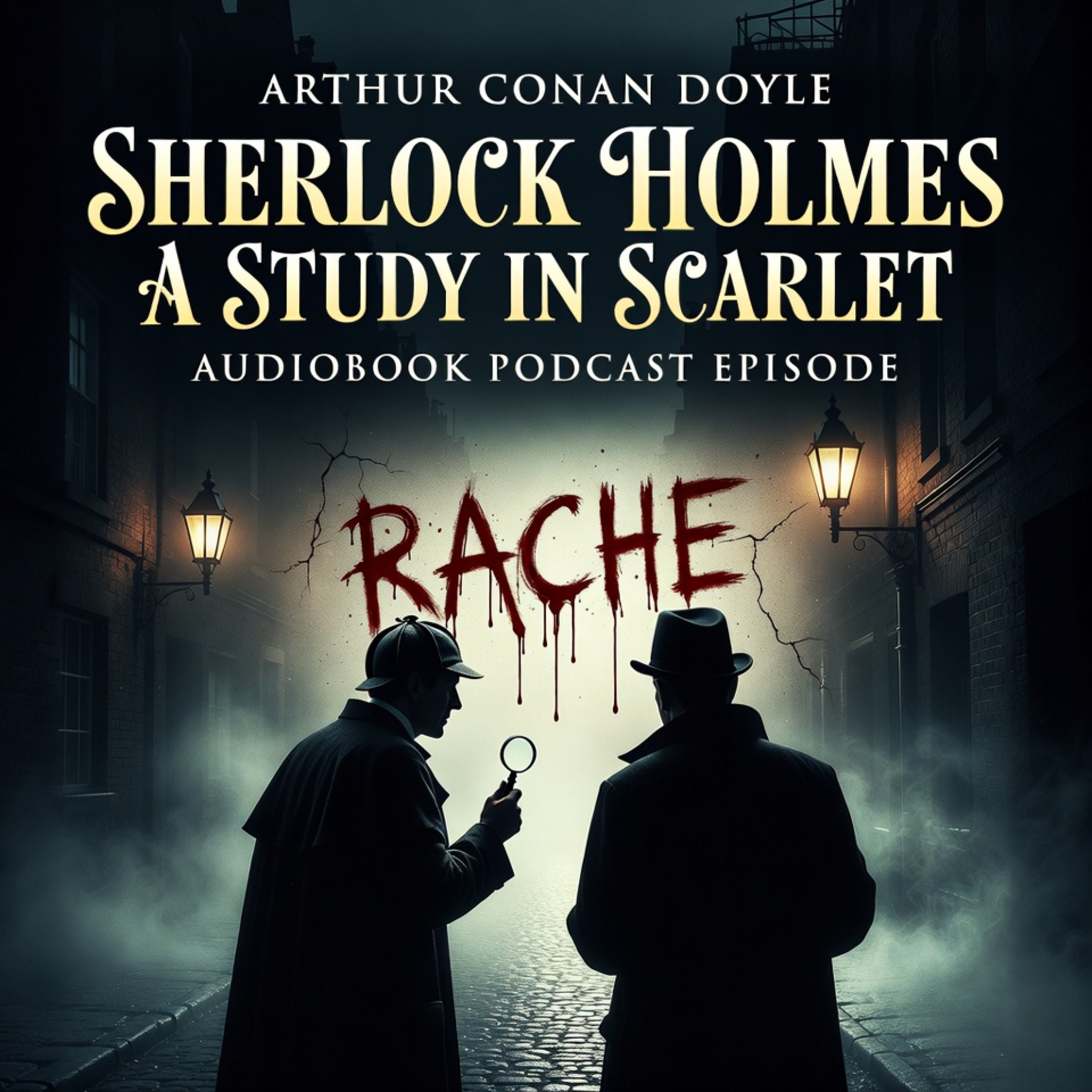
Sherlock Holmes: A Study in Scarlet - Chapters Five, Six and Seven | Full Audiobook
The Story
This episode is sponsored by Wexley Pro, a professional, mobile-first book-production studio for iPhone.
Write, edit, format, and export complete books in EPUB, DOCX, and print-ready PDF formats, with local-first manuscript processing designed to keep your creative work under your control.
Discover Wexley Pro: https://wexley.pro
In this episode, A Study in Scarlet reaches a turning point as the mystery deepens and the stakes rise.
Holmes sets a trap to draw out the unseen hand behind the crimes, only to discover that his adversary is more cunning—and less alone—than expected. Soon after, Inspector Gregson arrives with what appears to be a breakthrough, confidently announcing an arrest and presenting a compelling theory.
But the case refuses to settle. A second murder shatters every assumption, forcing a complete reexamination of the evidence. As rival detectives struggle to adapt, Sherlock Holmes quietly draws the scattered threads together—culminating in a bold move that brings the hidden killer into the light.
This episode completes Part One of the novel, resolving the mystery of Lauriston Gardens and setting the stage for the extraordinary story that follows.
This episodic audiobook series presents a modernized retelling of the original Sherlock Holmes canon, preserving the integrity of the stories while refining the language and structure for a more immersive listening experience.
Book One: A Study in Scarlet — Chapters Five, Six & Seven.New episodes release regularly.
Welcome back to another episodic audiobook presentation of Sherlock Holmes. In this series, each chapter brings the classic tales to life, unfolding the mystery, atmosphere, and adventure that have captivated readers for generations. Today's episode includes 3 chapters. If you're enjoying the journey, be sure to like, follow, or subscribe to stay updated with each new release. Before we begin, a brief note. This presentation of Sherlock Holmes is a modernized retelling of the original Canon. The cases remain faithful to the stories that generations have loved, while the language and structure have been carefully refined to create a smoother, more immersive listening experience for today's audience.
What you are about to hear is not a change to the mysteries themselves, but a restoration of their flow, allowing the world of Sherlock Holmes to unfold clearly for the modern ear. And now we return to the first case, Book 1A, Study in Scarlet, Chapter 5. Our advertisement brings a visitor. The morning's activities had taken a toll on my fragile health, leaving me exhausted by afternoon. After Holmes left for the concert, I stretched out on the sofa, hoping for a couple of hours of sleep. But sleep eluded me.
My mind was too stirred by the day's events, and it teemed with strange thoughts and speculations each time I close my eyes. The grotesque baboon like face of the murdered man loomed before me. The sinister impression it left was so strong that I felt a reluctant gratitude towards whoever had removed him from this world. If ever a face reflected the deepest vice, it was surely that of Enoch J Drebber from Cleveland. Yet I understood that justice must prevail, and the victim's depravity did not excuse his murder in the eyes of the law.
The more I pondered, the more remarkable Holmes's theory of poisoning seemed. I recalled how he had sniffed the man's lips, undoubtedly detecting something that sparked his suspicion. But if not poison, then what had caused the man's death, given there were no wounds or signs of strangulation? And whose blood was it that pooled so thickly on the floor? There were no indications of a struggle, nor did the victim possess any weapon with which he could have injured an attacker. As long as these questions remained unanswered, I knew sleep would be elusive for both homes and me.
His calm, assured demeanour suggested he had already devised a theory that accounted for all the facts, though I couldn't begin to guess what it might be. He returned very late, so late that I realized the concert couldn't have occupied all his time. Dinner was already on the table when he finally arrived. It was magnificent, he said, taking his seat. Do you recall what Darwin says about music? He argues that the ability to create and appreciate music existed in humanity long before the development of speech.
Perhaps that's why it influences us so profoundly. There are faint echoes in our souls from those ancient times when the world was young. That's quite a sweeping notion, I commented. One's ideas must be as expansive as nature if they are to interpret it, he replied. What's wrong? You don't seem quite yourself. This Brixton Rd. case has shaken you. To be honest, it has. I admitted I should be more resilient after my experiences in Afghanistan. I witnessed my fellow soldiers being brutally killed at my want, yet I kept my composure.
I understand there's something about this mystery that captures the imagination. Without imagination, there is No Fear. Have you seen the evening paper? No, I haven't. It provides a decent account of the incident. However, it omits the detail that when the man was lifted, a woman's wedding ring fell to the floor. It's probably for the best that it doesn't mention it. Why is that? Take a look at this advertisement, he replied. I had it placed in every paper this morning right after the incident. He tossed the paper to me and I looked at the spot he indicated.
It was the first listing in the found section on Brixton Road this morning, it read. A plain gold wedding ring was found on the road between the White Hart Tavern and Holland Grove. Inquire with Doctor Watson, 221B Baker Street, between 8:00 and 9:00 this evening. Forgive me for using your name, he said. If I used my own, some of these fools would recognize it and try to interfere with the matter. That's fine, I replied. But if someone does respond, I don't have a ring. Oh, but you do, he said, handing me one.
This will work perfectly. It's almost an exact match. And who do you think will respond to this ad? The man in the brown coat? Our rosy cheat friend with the square toed shoes. If he doesn't come himself, he'll send someone in his place. Wouldn't he find it too risky? Not at all. If my theory is correct, and I have every reason to believe it is, this man would rather take any risk than lose the ring. I suspect he dropped it while bending over Drebber's body and didn't notice at the time. After leaving, he realized it was missing and rushed back only to find the police already there.
Thanks to his own mistake of leaving the candle burning. He had to act drunk to avoid suspicion when he showed up at the gate. Now put yourself in his shoes. As he thought it over, he must have considered that he might have lost the ring on the road after leaving the house. What would he do then? He'd eagerly scan the evening papers, hoping to see it listed among the found items. Naturally, his attention would be drawn to this. He'd be thrilled. Why would he suspect a trap? In his mind, there'd be no link between finding the ring and the murder.
He would come. He will come. You'll see him within the hour. And then I inquired. Oh, leave that to me. Do you have any weapons? I have my old service revolver and a few cartridges. You should clean it and load it. He'll be a desperate man, and even though I'll catch him off guard, it's best to be prepared for anything. I went to my room and did as he suggested. When I returned with the pistol, the table was cleared and Holmes was absorbed in his favorite pastime, playing his violin. The plot thickens, he said as I entered.
I've just received a reply to my telegram to America. My theory about the case is correct. And what is that? I asked eagerly. My violin could use new strings, he commented. Put your pistol in your pocket. When the man arrives, just talk to him normally. Leave the rest to me. Don't scare him by staring too intensely. It's 8:00 now. I noted, checking my watch. Yes, he should be here shortly. Open the door a bit. That's enough. Now place the key inside. Thank you. I found this peculiar old book at a stall yesterday.
De jure Intergentes published in Latin in Liege in the lowlands back in 1642. Charles still had his head firmly attached when this little brown backed volume was printed. Who printed it? Philippe de Croix, whoever he was. On the flyleaf. In very faded ink it says Ex Libris Guliolmi White. I wonder who William White was? Probably some pedantic 17th century lawyer. His handwriting has a legal flair. Here comes our man, I think. As he spoke, the doorbell rang sharply. Sherlock Holmes rose quietly and adjusted his chair toward the door.
We heard the servant move down the hallway, followed by the sharp click of the latch as she opened the door. Does Doctor Watson live here? Asked a voice that was clear but somewhat grating. We couldn't catch the servant's response, but the door closed and someone began to climb the stairs. The footsteps were uncertain and shuffled. My companion's face registered surprise as he listened. The steps approached slowly down the passage and there was a weak knock at the door. Come in. I called out at Mom invitation.
Instead of the expected man of violence, a very old and wrinkled woman hobbled into the room. She seemed momentarily blinded by the sudden brightness of the light, and after dropping a curtsy, she stood blinking at us with her bleary eyes nervously fumbling in her pocket. With shaky fingers I glanced at my companion, whose face had taken on such a forlorn expression that it was all I could do to maintain my composure. The old woman pulled out an evening paper and pointed to our advertisement. It's this that brought me good gentlemen, she said, dropping another curtsy.
A gold wedding ring on Brixton Road. It belongs to my girl Sally, who was married just a year ago. Her husband is a steward on a union boat and what he'd say if he came home to find her without her ring is beyond me. Him being short tempered at the best of times, especially when he's been drinking. If you please. She went to the circus last night with. Is that her ring? I asked. Thank the Lord. Exclaimed the old woman. Sally will be overjoyed tonight. That's the ring. And what is your address? I inquired, picking up a pencil.
13 Duncan St. Houndsditch, quite a distance from here. The Brixton Rd. doesn't run between any circus and Houndsditch. Sherlock Holmes interjected sharply. The old woman turned to him, her small red rimmed eyes scrutinizing. The gentleman. Asked for my address. She replied. Sally stays in lodgings at 3 Mayfield Place, Peckham. And your name is? My name is Sawyer. Hers is Dennis, as she married Tom Dennis, a smart, tidy lad he is too, while at sea, and no steward in the company is more esteemed, but on shore with women and liquor shops.
Here is your ring, Missus Sawyer. I interrupted, following a discreet signal from Holmes. It clearly belongs to your daughter, and I'm pleased to return it to its rightful owner. With many murmured blessings and expressions of gratitude, the old woman tucked it away in her pocket and shuffled down the stairs. As soon as she was gone, Sherlock Holmes leapt to his feet and dashed into his room. He returned moments later, wrapped in an Ulster and a cravat. I'll follow her, he said urgently. She must be an accomplice and will lead me to him.
Wait up for me. The hall door had barely slammed shut behind our visitor before Holmes was already descending the stairs. Peering through the window, I watched her walk unsteadily along the opposite side, her pursuer trailing a short distance behind Either. His entire theory is flawed, I mused, or he's about to be LED straight to the core of the mystery. There was no need for him to ask me to stay awake. I knew I wouldn't be able to sleep until I learned the outcome of his venture. It was nearly 9 when he set out.
I had no sense of how long he might be gone, but I sat resolutely, puffing on my pipe and leafing through. Henri Murges, Vie de Boe, M 10:00 came and went, and I heard the maid's footsteps as she headed to bed. 11 struck and the more deliberate steps of the landlady passed my door bound for the same destination. It was almost midnight when I finally heard the sharp click of his key in the lock. The moment he entered, his expression told me he hadn't succeeded. Amusement and frustration seemed to vie for dominance until amusement won out and he broke into a hearty laugh.
I wouldn't want the Scotland Yard fellows to know about this for anything. He exclaimed, dropping into his chair. I've teased them so much that they'd never let me live it down. But I can laugh because I know I'll get the better of them eventually. What happened next? I asked. Well, I don't mind sharing a story at my own expense. That woman had barely walked a short distance before she started limping, clearly struggling with sore feet. Soon enough, she stopped and flagged down a passing 4 Wheeler.
I stayed close to catch the address, though I needn't have worried. She shouted it loud enough for anyone across the street to hear. Take me to 13 Duncan St. Hounds Ditch, she called out. This seemed promising, I thought, and after she settled inside, I discreetly hitched a ride on the back. That's a skill every detective should master. Off we went, rattling along until we reached the specified street. I jumped off before we arrived at the door and casually strolled down the street. I watched as the cab stopped.
The driver got down and opened the door, waiting expectantly, but nothing happened. By the time I reached him, he was rummaging frantically through the empty cab, cursing with a colorful array of oaths. That was quite something to hear. There was no sign of the passenger, and I suspect it'll be a while before he sees his fare. When we inquired at #13 we discovered the house belonged to a respectable paper hanger named Kezik, and no one by the name of Sawyer or Dennis had ever been heard of there.
You can't possibly mean. I exclaimed in disbelief that the frail, shaky old woman managed to leap from the cab while it was moving without either you or the driver noticing. Old woman, my foot. Sherlock Holmes retorted sharply. We were the fools to be so easily deceived. It had to be a young man, agile and a masterful actor at that. The disguise was flawless. He must have realized he was being tailed and used this trick to escape. This proves the man we're pursuing isn't as isolated as I thought.
He has allies willing to take risks for him. Now. Doctor, you look exhausted. Take my advice and get some rest. I was indeed feeling quite drained, so I followed his suggestion. I left home, sitting by the dying fire, and deep into the night I could hear the haunting, mournful strains of his violin, knowing he was still deep in thought, unraveling the peculiar mystery he had taken on. In Chapter 5, Holmes set a clever trap, placing a fake advertisement about the missing wedding ring to draw out the man he suspects was at the crime scene.
But instead of the suspect, A timid old woman arrived, only to vanish into the night after claiming the ring. Holmes, realizing too late that she was a disguised accomplice, gives chase but is outwitted. Though the ruse failed, it confirms his theory that adversary is not only dangerous but has allies and a cunning mind of his own. In the next chapter, Inspector Gregson steps into the spotlight, eager to prove his worth. He delivers a confident theory and makes an arrest. But Holmes isn't so easily convinced.
As rival detectives race for answers, the case begins to twist in unexpected directions. Chapter 6. Tobias Gregson shows what he can do. The newspapers the following day were abuzz with what they called the Brixton Mystery. Each carried an extensive report on the incident, with some even featuring editorials about it. I came across some details that were new to me in my scrapbook. I still keep numerous clippings and extracts related to the case. Here's a distilled version of a few of them. The Daily Telegraph noted that in the annals of crime, few tragedies have displayed such peculiar characteristics.
The victim's German name, the lack of any other apparent motive, and the ominous message scrawled on the wall all suggested the involvement of political refugees and revolutionaries. Socialists had many factions in America and it seemed the deceased had violated their unwritten rules and was haunted down by them. The article, with a touch of levity, referenced the Vengaricht Aqua Tofana, the Carbonari, the Martianess de Brinvilier, the Darwinian theory, the principles of Malthus, and the Ratcliffe Hwy.
murders, before concluding with a warning to the government and a call for stricter surveillance of foreigners in England. The Standard observed that such lawless acts typically occurred under a liberal administration. They were attributed to the disturbance of the public's mindset and the resulting erosion of authority. The deceased was an American gentleman who'd been living in the city for several weeks. He'd been staying at Madame Charpentier's boarding house on Torquay Terrace, Camberwell, and was travelling with his private secretary, Mr. Joseph Stangerson.
On Tuesday the 4th, the two men bid farewell to their landlady and set off for Houston Station, claiming they intended to catch the express train to Liverpool. They were last seen together on the platform. After that, nothing more was known until Mr. Drebber's body was found in an empty house on Brixton Road, far from Houston. How he ended up there and the circumstances of his death remain shrouded in mystery. Stangerson's whereabouts are still unknown. We are pleased to report that Mister Lestrade and Mr. Gregson from Scotland Yard are on the case and there is strong confidence that these esteemed detectives will soon shed light on the situation.
The Daily News noted that the crime was undoubtedly political. The oppressive regimes and their disdain for liberalism on the continent had driven many individuals to our shores, people who might have been exemplary citizens if not embittered by their past experiences. Among these exiles, there existed A strict code of honor, violations of which were punishable by death. It is crucial to locate the Secretary Stangerson and gather details about the deceased's lifestyle. A significant breakthrough was achieved with the discovery of the address where he had been staying, a result entirely credited to the sharpness and diligence of Mr. Gregson from Scotland Yard.
Sherlock Holmes and I perused the morning notices together over breakfast and they seemed to provide him with a good deal of amusement. I told you, no matter the outcome, Lestrade and Gregson would claim success. That depends on the result. Oh, it hardly matters. If the culprit is apprehended, it will be due to their efforts. If he escapes, it will be despite them. It's a win win for them. Whatever happens, they'll have their admirers. A fool always finds a greater fool to admire him. What on earth is happening?
I exclaimed as the sound of many footsteps echoed in the hall and on the stairs, accompanied by our landlady's audible expressions of disapproval. It's the Baker Street division of the detective police force, my companion said gravely. As he spoke, half a dozen of the dirtiest and most ragged St. Urchins I'd ever seen burst into the room. Attention. Holmes barked sharply, and the six grimy little rascals lined up like a row of disreputable statuettes. From now on, Wiggins will report alone, and the rest of you must wait outside.
Have you found it, Wiggins? No, Sir, we haven't, one of the young lads replied. I didn't really think you would keep at it. Until you do, here are your wages. He handed each of them a shilling. Now off you go and bring back a better report next time. He waved them off and they dash downstairs like a pack of rats. They're high pitched voices echoing in the street moments later. You can get more work out of one of those little rascals than from a dozen officers. Holmes observed. The mere presence of someone official looking makes people clam up.
These kids though, they go everywhere and hear everything. They're sharp as needles. All they need is a bit of organization. Are you using them for this Brixton case? I inquired. Yes, there's something I need to find out. It's just a matter of time. We're about to get some news now, and in a big way. Here comes Gregson down the road, looking positively radiant. He's headed our way, I'm sure. Yes, he's stopping. There he is. A sharp ring echoed through the house and moments later the fair haired detective bounded up the stairs, taking them three at a time, and burst into our sitting room.
My dear fellow. He exclaimed, shaking Holmes's unresponsive hand with enthusiasm. Congratulate me, I've made everything as clear as day. I noticed a flicker of concern Passover my companion's expressive face. Do you mean you're on the right track? He enquired. The right track? Why? We've got the man locked up. Gregson declared with pomp, rubbing his hands together and puffing out his chest. What's his name? Holmes asked Arthur Charpentier, sub Lieutenant in Her Majesty's Navy. Gregson announced, his voice swelling with pride.
Sherlock Holmes sighed with relief and allowed a smile to form. Take a seat and try one of these cigars. He offered. We're eager to hear how you accomplished it. Would you like some whiskey and water? I wouldn't mind, The detective replied. The intense effort of the past couple of days has worn me out. Not so much physically, you understand, but the mental strain has been considerable. You'll understand, Mr. Sherlock Holmes, since we're both engaged in cerebral pursuits. You flatter me, Holmes replied with a serious nod.
Please share how you reach this most satisfying conclusion. The detective settled into the armchair, exhaling contentedly on his cigar. Suddenly, he slapped his thigh, overcome with amusement. The best part? He exclaimed, is that fool Lestrade, who fancies himself so clever, is chasing the wrong lead entirely. He's after the secretary Stangerson, who is as innocent as a newborn. I'm sure he's already apprehended him by now. The thought amused Gregson so much that he laughed until he nearly choked.
And how did you uncover your clue? I'll explain everything. Of course, Doctor Watson, this is strictly confidential. Our initial challenge was tracing this American's background. Some might have waited for responses to their ads or for people to come forward with information. That's not how Tobias Gregson operates. Do you recall the hat found beside the deceased? Yes, Holmes affirmed. From John Underwood and Sons, 129 Camberwell Road. Gregson appeared deflated. I didn't realize you caught that, he admitted.
Have you visited them? No. Ah, Gregson exclaimed, visibly relieved. You should never overlook any opportunity, no matter how insignificant it seems to a great mind. Nothing is insignificant, Holmes replied with a touch of gravitas. Well, I went to Underwood and inquired if they had sold a hat matching that size and description. He checked his records and found it immediately. The hat had been sent to a Mr. Drebber who was staying at Charpentier's boarding establishment on Torquay Terrace. That's how I got his address.
Smart, very smart, Sherlock Holmes murmured. I then visited Madame Charpentier, the detective continued. She seemed very pale and troubled. Her daughter was there as well, a remarkably striking young woman. Her eyes were red and her lips quivered. As I spoke to her, I didn't miss that I began to suspect something was amiss. You know the sensation, Mr. Sherlock Holmes, when you catch the right trail. A kind of electric thrill running through your nerves. Have you heard about the mysterious death of your former tenant, Mr. Enoch J Drebber from Cleveland?
I inquired. The mother nodded, seemingly unable to speak. The daughter broke into tears. It became increasingly clear to me that these people were hiding something about the incident. What time did Mr. Drebber leave your house to catch the train? I asked. At 8:00, she replied, swallowing hard to suppress her distress. His secretary, Mr. Stangerson, mentioned there were two trains, one at 9:15 and another at 11. He was supposed to take the 1st. And was that the last time you saw him? As I posed the question, a dreadful transformation swept over the woman's face.
Her features turned ashen. It took several seconds before she could utter the single word Yes, and when she did, it was in a hoarse, unnatural voice. There was a brief silence, then the daughter spoke in a calm, clear voice. No good can ever come from deceit, Mother, she said. We should be honest with this gentleman. We did see Mr. Drebber again. God forgive you, cried Madame Charpentier, throwing her hands up and collapsing into her chair. You've doomed your brother. Arthur would prefer we tell the truth, the girl replied with determination.
You'd better tell me everything now, I said. Half truths are worse than none. Besides, you don't know how much we already know on your head. Be it Alice? Her mother exclaimed. Then turn to me. I will tell you everything, Sir. Don't think my distress for my son stems from any fear that he was involved in this dreadful affair. He is completely innocent. My fear is that in your eyes and others, he might seem implicated, but that must be impossible. His good character, his profession, his history would all prevent it.
The best course is to be completely honest, I replied. Trust me, if your son is innocent, he will not suffer for it. Perhaps, Alice, it would be best if you left us alone, she said and her daughter quietly exited the room. Now, Sir, she continued. I hadn't planned on revealing all this to you, but since my poor daughter has let it slip, I have no choice. Having decided to speak, I will tell you everything without leaving out any details. That is the wisest decision, I replied. Mr. Drebber has been staying with us for nearly three weeks.
He and his secretary, Mr. Stangerson, had been travelling across Europe. I noticed a Copenhagen label on each of their suitcases indicating that was their last stop. Stannison was a quiet, reserved man, but his employer, I regret to say, was quite the opposite. He was coarse and brutish in his behaviour on the very night he arrived. He drank excessively an afternoon each day. He was rarely sober. His behaviour towards the maidservants was disgustingly familiar and inappropriate. Worst of all, he soon adopted the same demeanour towards my daughter Alice, speaking to her in ways that thankfully, she was too innocent to comprehend.
On one occasion he even grabbed her and embraced her, an outrage that prompted his own secretary to reprimand him for his disgraceful conduct. But why did you tolerate all this? I asked. I assume you can dismiss your tenants whenever you choose. Missus Charpentier flushed at my direct question. I wish I had told him to leave the very day he arrived, she confessed. But it was a difficult temptation. They were paying a pound a day each, £14.00 a week, and this is the slow season. I'm a widow and my son in the Navy has been expensive.
I hated to lose the income. I thought I was doing the right thing. But the last incident was too much and I finally gave him notice to leave because of it. That's why he left. And then my heart felt lighter when I saw him drive away. My son is home on leave right now, but I didn't tell him any of this as he has a fierce temper and is very protective of his sister. When I closed the door behind them, it felt like a weight had been lifted from my mind. Unfortunately, less than an hour later, the doorbell rang and I discovered Mr. Drebber had returned.
He was visibly agitated and clearly intoxicated. He barged into the room where I was sitting with my daughter and mumbled something incoherent about missing his train. He then turned to Alice and right in front of me, asked her to run away with him. You're of age, he said. And nothing can legally stop you. I've got more than enough money. Forget about the old woman here, just come with me right now. You'll live like royalty. Poor Alice was so scared, she recoiled from him, but he grabbed her wrist and tried to pull her towards the door.
I screamed and at that moment my son Arthur entered the room. What happened next I can't say. I heard curses and the chaotic sounds of a struggle. I was too terrified to lift my head. When I finally looked up, I saw Arthur standing in the doorway, laughing with a stick in his hand. I don't think that scoundrel will bother us again, he said. I'll just follow him and see what he gets up to. With that, he grabbed his hat and headed down the street. The next morning, we heard about Mr. Drebber's mysterious death.
Missus Charpentier spoke with many interruptions, her voice often so faint that I struggled to catch her words. Nevertheless, I took shorthand notes to ensure there would be no room for error. Quite thrilling, Sherlock Holmes remarked with a yawn. What followed? When Missus Charpentier paused, the detective continued. I realized the entire case hinged on a single detail, locking eyes with her, a technique I found particularly effective with women. I asked her what time her son returned home. I don't know, she replied.
You don't know? No. He has a latch key and let himself in. After you went to bed? Yes. When did you retire for the night? Around 11. So your son was out for at least two hours? Yes. Possibly four or five, Yes. What was he doing during that time? I don't know, she replied, her face turning pale as her lips. After that, there was nothing more to be done. I located Lieutenant Charpentier, took two officers with me and arrested him. When I placed a hand on his shoulder and told him to come quietly, he responded with surprising boldness.
I suppose you're arresting me for being involved in that scoundrel Drebber's death. He said we hadn't mentioned anything about it to him, so his reference to it seemed highly suspicious. Very, Holmes remarked. He still carried the heavy stick his mother had described, the one he had with him when he followed Drebber. It was a sturdy oak cudgel. So what's your theory? My theory is that he followed Drebber to Brixton Rd. There another argument broke out between them, during which Drebber received a blow from the stick, perhaps in the stomach, that killed him without leaving a mark.
The night was so rainy that no one was around, so Charpentier dragged the body into the empty house. As for the candle, the blood, the writing on the wall, and the ring, they could all be tricks to mislead the police. Well done. Holmes said, his voice warm with encouragement. Truly, Gregson, you're making progress. We'll turn you into something remarkable, yet I must say I've handled it quite deftly. The detective replied with pride. The young man offered a statement claiming that after trailing Drebber for a while, Drebber noticed him and took a cab to escape.
On his way home, he ran into an old shipmate and went for a long walk with him. When asked where this shipmate lived, he couldn't provide a satisfactory answer. I believe the pieces of the case fit together remarkably well. What tickles me is imagining Lestrade, who set off on the wrong track. I'm afraid he won't get far with it. Why, by Jove, here he is now. Indeed, it was Lestrade who had climbed the stairs during our conversation and now entered the room. The usual confidence and flair in his demeanour and attire were conspicuously absent.
His face was troubled, his clothes dishevelled. Clearly he intended to consult Sherlock Holmes, for upon seeing his colleague, he seemed embarrassed and uneasy. He stood in the middle of the room, nervously fiddling with his hat, unsure of his next move. This is an utterly extraordinary case, he finally said. A truly baffling affair. Ah, you see it that way too, Mr. Lestrade. Gregson exclaimed with a note of triumph. I suspected you'd reach that conclusion. Have you located the secretary, Mr. Joseph Stangerson?
The secretary, Mr. Joseph Stangerson Lestrade replied with Gravity was murdered at Halliday's private hotel around 6:00 this morning. In Chapter 6, Inspector Gregson bursts in with pride, claiming to have solved the Brixton Rd. mystery Through diligent legwork, he tracks the victim, Enoch Drebber, to a London boarding house where tensions had flared between Drebber and the landlady's daughter. Her brother Arthur Charpentier is arrested after Gregson pieces together a plausible motive and timeline, one that seems to fit the facts.
But while Gregson basks in his moment, Holmes remains quietly unconvinced. Something doesn't add up. And just as Gregson declares victory, Inspector Lestrade arrives, pale, dishevelled, and with a stunning revelation that shatters Gregson's theory entirely. Chapter 7 Light in the Darkness The news Lestrade delivered was so significant and unexpected that it left all three of us stunned. Gregson leapt from his chair, spilling what remained of his whiskey and water. I stared silently at Sherlock Holmes, whose lips were tightly pressed and brows furrowed in concentration.
It's dangerous. And too, he murmured. The plot thickens. It was already dense enough. Lestrade grumbled, settling into a chair. I feel like I've stumbled into some kind of war council. Are you, are you certain about this information? Gregson stammered. I've just come from his room, Lestrade replied. I was the first to discover what happened. We've been hearing Gregson's perspective on the matter, Holmes noted. Would you mind sharing what you've seen and done? I have no objection, Lestrade said, taking a seat.
I must admit, I initially believed Stangerson was involved in Drebber's death. This new development has shown me I was completely wrong. Focused on that idea, I set out to find what happened to the secretary. They were last seen together at Houston Station around 8:30 on the evening of the third. By two in the morning, Drebber was found on Brixton Road. The challenge was to determine how Stangerson spent his time between 8:30 and the crime and what became of him afterward. I sent a telegram to Liverpool with his description, advising them to monitor the American ships.
Then I began visiting all the hotels and lodging houses near Houston. My reasoning was that if Drebber and his companion had parted ways, the latter would likely find a place to stay nearby for the night and return to the station the next morning. They would probably agree on a meeting place beforehand, Holmes remarked. Indeed, that's how it unfolded. I spent all of last evening making inquiries, but they led nowhere. This morning I started early and by 8:00 I arrived at Halliday's Private Hotel on Little George St. When I asked if a Mr. Stangerson was staying there, they immediately confirmed it.
You must be the gentleman he's been expecting, they said. He's been waiting for someone for two days. Where is he now? I inquired. He's upstairs in bed. He asked to be woken at 9:00. I'll go up and see him right away, I replied. I thought my unexpected arrival might unsettle him and cause him to say something. Without thinking, the hotel Porter offered to show me to the room. It was on the 2nd floor with a narrow corridor leading to it. The Porter pointed out the door and was about to head back downstairs when I noticed something that turned my stomach.
Despite my 2 decades of experience, a thin red ribbon of blood was seeping from under the door, winding across the passage and pooling along the baseboard on the opposite side. I cried out, which brought the Porter back. He nearly fainted at the sight. The door was locked from the inside, but we forced it open with our shoulders. The window in the room stood ajar, and beside it, crumpled on the floor, lay the body of a man in his nightclothes. He was unmistakably dead, and had been for some time.
His limbs were stiff and cold. When we turned him over, the boots immediately recognized him as the gentleman who had rented the room under the name Joseph Stangerson. The cause of death was a deep stab wound on the left side, likely piercing the heart. And now we come to the most peculiar aspect of the case. What do you think was above the murdered man? Even before Sherlock Holmes replied, I felt a chill run through me, a foreboding of the horror to come. The word rage written in letters of blood, he said.
That's right. Lestrade confirmed, his voice filled with awe, and we all fell silent for a moment. There was something so calculated and yet so baffling about the actions of this unknown killer that it added a new layer of dread to his crimes. My nerves, which had held steady even in battle, tingled at the thought. The man was seen. Lestrade continued. A milk boy on his way to the dairy happened to walk down the lane that runs from the muse behind the hotel. He noticed a ladder, typically resting on the ground, now propped against a second floor window, which stood wide open.
As he walked past, he glanced back and observed a man descending the ladder. The man moved so quietly and openly that the boy assumed he was a Carpenter or joiner working at the hotel. He didn't pay much attention, merely thinking it was an early hour for such work. He recalls the man being tall with a reddish face and wearing a long brownish coat. The man must have lingered in the room for a while after the murder as they found blood stained water in the basin where he had washed his hands and marks on the sheets where he had wiped his knife deliberately.
I looked at Holmes as I heard the description of the murderer which matched his own so precisely, yet there was no sign of triumph or satisfaction on his face. Did you find anything in the room that could lead us to the murderer? He inquired. Nothing. Stangerson had Drebber's purse in his pocket, but that seemed normal since he handled all the payments. There were over £80 in it, but nothing was missing. Whatever the motives behind these extraordinary crimes, robbery is certainly not one of them.
There were no papers or notes in the murdered man's pocket, save for a lone telegram dated from Cleveland about a month prior, which simply read JH is in Europe. The message bore no signature and nothing else. Holmes inquired. Nothing of significance. The man had a novel which he had evidently been reading before falling asleep. Lying on the bed. His pipe rested on a chair beside him. A glass of water was on the table, and on the window sill sat a small ointment box containing a couple of pills.
Sherlock Holmes leapt from his chair with a cry of triumph. The final piece? He exclaimed, jubilant. My case is complete. The two detectives looked at him astonished. I now hold my companion declared with assurance all the threads that have been so entangled. There are naturally details to be filled in, but I am as certain of the main events, from when Drebber parted ways with Stangerson at the station, to the discovery of Stangerson's body, as if I had witnessed them myself. I will demonstrate my understanding.
Could you produce those pills? I have them, Lestrade replied, pulling out a small white box. I took them along with the purse and the telegram, intending to secure them at the police station. It was sheer coincidence that I ended up with these pills, as I must admit I don't really think much of them. Let me see them, said Holmes. Now, Doctor, He turned to me. Are these ordinary pills? They were anything but ordinary. They were a pearly grey, small, round and nearly see through when held up to the light.
Given their lightness and transparency, I guess they're water soluble, I observed. Exactly, Holmes replied. Now could you go and bring up that poor little terrier that's been suffering for so long, the one the landlady asked you to put out of its misery yesterday I went downstairs and gently carried the dog back up. It's laboured breathing and glazed eyes made it clear it was near the end. It's Snow White muzzle showed it It already outlived the typical lifespan for a dog. I set it down on a cushion by the rug.
I'll cut one of these pills in half now, said Holmes, pulling out his pen knife and doing just that. 1/2 goes back in the box for later. The other half I'll place in this wine glass with a teaspoon of water. You see, our friend the doctor was right. It dissolves easily. This might be quite intriguing. Lestrade remarked, his voice tinged with the irritation of someone who feels mocked. Yet I fail to see how it relates to Mr. Joseph Stangerson's death. Patience, my dear friend, patience. In due time, you'll realize it has everything to do with it.
Now I'll add a bit of milk to make the concoction more appealing, and when we offer it to the dog, you'll see he drinks it eagerly. As he spoke, Holmes poured the contents of the wine glass into a saucer and set it before the terrier, who promptly licked it clean. Holmes's serious demeanour had convinced us to sit silently watching the animal closely, anticipating some dramatic reaction. Yet nothing happened. The dog remained sprawled on the cushion, breathing heavily but seemingly unaffected by the drink.
Holmes checked his watch, and as the minutes ticked by without any change, his face showed deep frustration and disappointment. He bit his lip, tapped his fingers on the table, and exhibited every sign of intense impatience. His agitation was so palpable that I genuinely felt sorry for him, while the 2 detectives smirked, clearly enjoying his set back. It can't be mere coincidence. He exclaimed, finally leaping from his chair and pacing the room in agitation. It's impossible that this is just a coincidence.
The very pills I suspected in Drebber's case are indeed found after Stangerson's death, and yet they remain inert. What could this possibly mean? Surely my entire line of reasoning can't be flawed. It's unthinkable. And yet this poor dog shows no I'll effects. I've got it, I've got it. With a triumphant cry, he dashed to the box, split the other pill in two, dissolved it, mixed it with milk and offered it to the terrier. The unfortunate animal barely touched it with its tongue before it convulsed violently, every limb shuddering, and then lay still and lifeless, as if struck by lightning.
Sherlock Holmes exhaled deeply, wiping sweat from his brow. I should have more faith, he remarked. By now I ought to realize that when a fact seems to contradict a long chain of deductions, it invariably can be interpreted another way. Of the two pills in that box, 1 was lethally poisonous, while the other was completely harmless. I should have known that before I even laid eyes on the box. This revelation was so astonishing to me that I could scarcely believe he was in his right mind. Yet the dead dog was undeniable proof that his hypothesis was correct.
It felt as though the fog in my own mind was slowly lifting, and I began to perceive the truth, albeit dimly and vaguely. All this seems strange to you, Holmes continued. Because at the outset of the investigation, you failed to grasp the significance of the single real clue that was right in front of you. I was fortunate to latch onto that insight, and everything since has only reinforced my initial theory, following logically from it. What has puzzled you and clouded the case has actually clarified things for me and solidified my conclusions.
It's a mistake to confuse the unusual with the mysterious. Often the most ordinary crime is the most enigmatic because it lacks distinctive features from which to draw conclusions. This murder would have been far harder to solve if the victim's body had simply been found lying in the street, devoid of those bizarre and sensational elements that made it stand out. These peculiar details, rather than complicating the case, have actually simplified it. Mr. Gregson, who had been listening with growing impatience, could hold back no longer.
Listen, Mr. Sherlock Holmes, he said. We all recognize that you're a clever man with your own way of doing things, but we need more than just theories and lectures. Now it's time to catch the culprit. I thought I had my case wrapped up, but it turns out I was mistaken. Young Charpentier couldn't have been involved in this second incident. Lestrade pursued Stangerson, but it seems he was mistaken as well. You've been dropping hints here and there suggesting you know more than we do. The time has come for us to ask directly.
How much do you really know about this case? Can you identify the culprit? I can't shake the feeling that Gregson is correct, Sir, Lestrade interjected. We've both made attempts and come up short. You've mentioned more than once since I've been here that you possess all the evidence you need. Surely you won't keep it from us any longer. Any delay in apprehending the murderer? I pointed out. Might allow him the opportunity to commit another heinous act. Pressed by all of us, Holmes showed signs of hesitation.
He continued pacing the room, head bowed and brows furrowed as he often did when deep in thought. There will be no further murders. He finally declared, stopping abruptly and facing us. You can dismiss that concern. You've asked if I know the Assassin's name. I do. Knowing his name is a minor victory compared to actually getting our hands on him. I expect to accomplish this soon. I have a plan in place, but it requires A delicate touch. We're dealing with a sharp and dangerous man backed by someone equally cunning.
As long as he remains unaware that anyone is on to him, we have a chance to catch him. But if he even suspects, he'll change his identity and disappear into the city's 4 million souls. I mean no offense, but I believe these men outmatched the official force, which is why I haven't sought your help. If I fail, I'll accept the blame for that decision, but I'm prepared for it. I promise to contact you the moment I can do so without jeopardizing my strategy. Gregson and Lestrade were clearly not pleased with this explanation or the slight against the detective police.
Gregson flushed to the roots of his blonde hair while Lestrade's eyes shone with a mix of curiosity and irritation. Before either could respond, there was a knock at the door and young Wiggins, the leader of the street urchins, made his unremarkable and somewhat grimy entrance. Please, Sir, he said, touching his forelock. I've got the cab downstairs. Good boy, Holmes said with a calm demeanour. Why not introduce this design at Scotland Yard? He continued, retrieving a pair of steel handcuffs from a drawer.
Observe how smoothly the spring operates. They lock instantly. The old design works well enough, Lestrade replied. If only we can find the right man to put them on. Very good, very good. Holmes said with a smile. The cab man might as well help me with my luggage. Wiggins, please ask him to come up. I was taken aback to hear my companion speaking as if he were preparing for a trip, as he hadn't mentioned anything to me about it. A small suitcase was in the room, which he pulled out and began to fasten.
He was engrossed in this task when the cab man entered. Could you help me with this buckle, Cab man? Holmes asked, focused on his work and not turning his head. The man approached with a somewhat sullen, defiant expression, reaching out to assist. In that instant there was a sharp click, the clatter of metal, and Sherlock Holmes leapt to his feet. Gentlemen, he announced, His eyes are light. Allow me to introduce Mr. Jefferson Hope, the murderer of Enoch Drebber and Joseph Stangerson. The entire scene unfolded in a flash, so swiftly that I had no time to comprehend it.
I vividly remember that moment, Holmes's triumphant look, the commanding tone of his voice, and the cab man's bewildered, furious expression as he stared at the handcuffs that it seemingly materialized on his wrists. For a brief moment, we were like statues, frozen in time. Then, with a guttural roar of rage, the prisoner tore himself from Holmes's grip and launched himself through the window. The wood and glass shattered around him, but before he could escape, Gregson, Lestrade, and Holmes pounced on him like a pack of hounds.
They dragged him back into the room, igniting A fierce struggle. His strength was astonishing, almost convulsive, as if he were in the throes of an epileptic fit. Despite his face and hands being badly cut from the glass, the blood loss did nothing to weaken his resistance. It wasn't until Lestrade managed to get a hand inside his neckloth and half strangle him that he realized his efforts were futile. Even then, we felt no relief until we had bound his feet as securely as his hands. Exhausted and gasping for breath, we finally stood up.
We have his cab, Sherlock Holmes said it will do to take him to Scotland Yard. And now, gentlemen. He said with a warm smile. We've come to the conclusion of our little mystery. Feel free to ask me anything you'd like. I'm more than willing to provide answers. With the second murder revealed, Holmes wastes no time. As Lestrade and Gregson scramble to adjust their theories, Holmes quietly traces the final threads. Then, in a moment of calm precision, springs his trap. The man behind both killings is caught not through luck, but through luck logic, not through force, but by following the smallest details no one else could see.
In just a few steps, Holmes does what the official detectives could not. He solves the case. But even with the killer in custody, one question remains. Why? What drove a man across continents, through years of silence, to murder not once, but twice? Part 2 The story rewinds. We leave the fog of London behind and travel across the Atlantic to the deserts of the American West. There, in a land of faith, isolation, and vengeance, we uncover the hidden past that gave birth to the mystery of Lauriston Gardens.
The answers lie not in the streets of London, but in the shadows of Utah. You've been listening to Sherlock Holmes, the 221 B Chronicles, an episodic audio book presentation of Sherlock Holmes. Thank you for joining us. We'll be back with the next two chapters in our next release. Until then, the case continues.
 Apple Podcasts
 Castbox
 Castro
 Goodpods
 Moon FM
 Overcast
 Pocket Casts
 Podbean
 Podcast Addict
 Podcast Republic
 Spotify